Have you ever wondered whether to write troop or troupe when referring to a group of people? These two words sound exactly alike, but their meanings are quite different. Confusing them can change the meaning of a sentence, especially when you’re writing about the military, scouts, performers, or entertainers.
Understanding troop vs troupe is easier than it might seem. Troop generally refers to a group of soldiers, scouts, or people working together, while troupe describes a company or group of performers, such as actors, dancers, or musicians.
Although both words are pronounced the same way, knowing when to use each one will make your writing more accurate. Let’s explore their definitions, differences, examples, and easy ways to remember the correct spelling.
Troop vs Troupe: What’s the Difference?
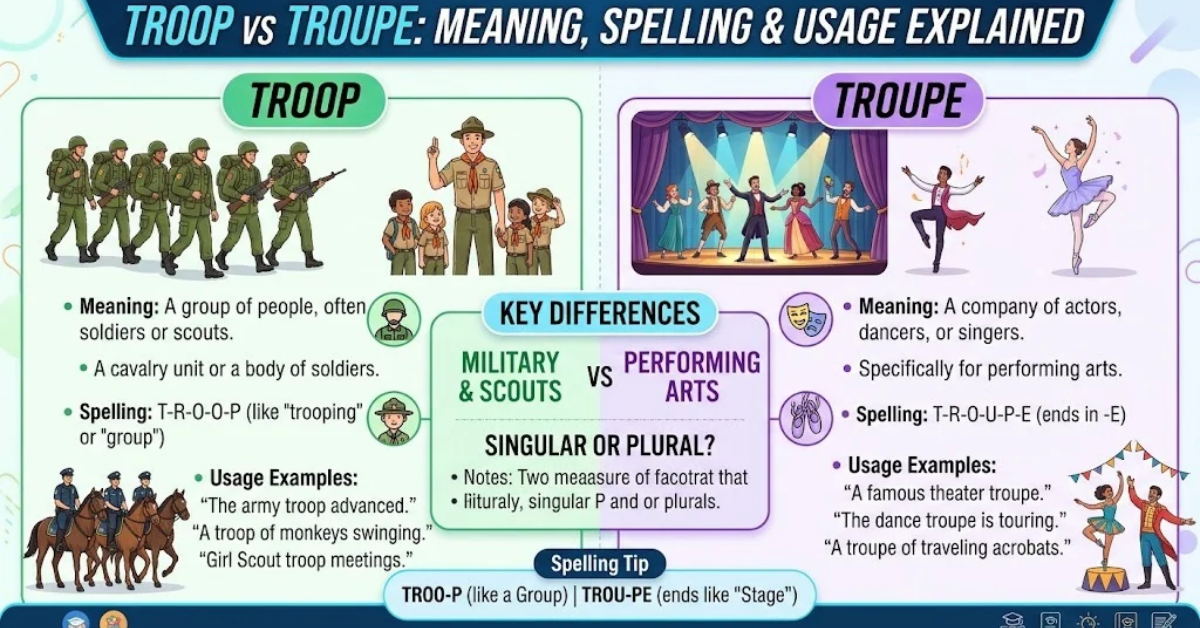
The main difference between troop and troupe is the type of group each word describes.
- Troop: A group of soldiers, scouts, or other people organized for a particular purpose.
- Troupe: A group of performers who work together in theatrical, musical, dance, or entertainment productions.
Both words are nouns, and both can refer to collections of people. However, they are not interchangeable because they describe different kinds of groups.
Here’s a quick comparison:
| Feature | Troop | Troupe |
| Meaning | An organized group of people, often soldiers or scouts | A company of performers |
| Common context | Military, scouting, organized groups | Theater, dance, music, entertainment |
| Part of speech | Noun; also a verb | Noun |
| Pronunciation | Troop | Troop |
| Example | A troop of soldiers arrived. | A troupe of dancers performed. |
The easiest way to remember the distinction is that troops are associated with soldiers and scouts, while troupes are associated with performers.
What Does Troop Mean?
The word troop refers to a group of people, particularly soldiers, scouts, or individuals organized for a shared activity or purpose.
It is commonly used in military and scouting contexts, although it can also describe groups of animals or people moving together.
For example:
- “The troop of soldiers returned to the military base.”
- “Our scout troop organized a weekend camping trip.”
- “A troop of monkeys was spotted near the forest.”
- “The rescue troop arrived shortly after the emergency call.”
In each sentence, troop describes a group rather than a company of entertainers.
Different Meanings and Uses of Troop
The word troop has several related meanings depending on the context.
1. Military group
In military language, a troop can refer to a group of soldiers or an organized military unit. The exact size and structure depend on the military organization and country.
Example: “The troops were sent to assist with the operation.”
2. Scout organization
In scouting, a troop is an organized group of young people who participate in activities such as camping, community service, outdoor education, and leadership development.
Example: “My daughter joined a local Girl Scout troop.”
3. Group of animals
The word can also describe certain groups of animals, particularly monkeys and baboons.
Example: “A troop of baboons crossed the road.”
4. People moving together
More generally, troop can describe a group of people gathered or moving together.
Example: “A troop of excited children entered the classroom.”
Can Troop Be Used as a Verb?
Yes. Although troop is most commonly used as a noun, it can also function as a verb.
As a verb, to troop means to move or gather together in a group, often in an orderly or coordinated way.
Examples:
- “The students trooped into the auditorium.”
- “Everyone trooped outside after the meeting.”
- “The children trooped toward the playground.”
This usage is often informal and describes people moving together.
What Does Troupe Mean?
A troupe is an organized group of performers who work together to entertain an audience.
These performers may include actors, dancers, singers, musicians, comedians, circus artists, or other entertainers.
A troupe typically travels, rehearses, and performs together, although not every troupe needs to travel from place to place.
For example:
- “The dance troupe performed beautifully at the festival.”
- “A traveling theater troupe visited our town.”
- “The comedy troupe entertained the audience with hilarious sketches.”
- “She joined a professional ballet troupe after graduation.”
In all these examples, troupe refers specifically to a group associated with entertainment or performing arts.
Different Types of Troupes
Troupes can specialize in different forms of performance and entertainment.
1. Dance troupe
A dance troupe consists of dancers who perform together, often specializing in a particular style, such as ballet, hip-hop, contemporary, or traditional dance.
Example: “The dance troupe won first place in the competition.”
2. Theater troupe
A theater troupe is a group of actors and other performers who collaborate on stage productions.
Example: “The theater troupe rehearsed for several weeks before opening night.”
3. Comedy troupe
A comedy troupe consists of comedians or performers who work together to create humorous shows, sketches, or improvisational performances.
Example: “The comedy troupe performed an entertaining live show.”
4. Circus troupe
A circus troupe is a group of entertainers who perform circus acts, which may include acrobatics, juggling, aerial performances, and other specialized skills.
Example: “The circus troupe amazed the crowd with its acrobatic routines.”
5. Musical troupe
A musical troupe is a group of performers who work together to present musical entertainment, sometimes combining singing, dancing, and acting.
Example: “The musical troupe traveled across the country.”
Troop vs Troupe: Examples in Sentences
One of the easiest ways to understand the difference between these words is to see them used in everyday sentences.
Here are some examples to help you recognize the correct word.
Examples of Troop in a Sentence
- The troop of soldiers marched across the field.
- Our scout troop collected donations for a local charity.
- A troop of monkeys climbed through the trees.
- The military troop received new equipment.
- Several troops were deployed to support the mission.
- The children trooped into the classroom after lunch.
- The scout troop planned an overnight camping adventure.
Examples of Troupe in a Sentence
- The dance troupe performed at the cultural festival.
- A theater troupe presented a new production.
- The comedy troupe made everyone laugh.
- The circus troupe entertained families throughout the evening.
- She became a member of a professional acting troupe.
- The musical troupe performed several popular songs.
- A traveling troupe brought live entertainment to the village.
How to Choose Between Troop and Troupe
When deciding which spelling to use, consider what kind of group you’re describing.
Ask yourself:
- Are you talking about soldiers, scouts, or an organized group of people? Use troop.
- Are you referring to actors, dancers, musicians, or entertainers? Use troupe.
- Are you describing people moving together as a group? Use troop as a verb.
This simple approach will help you avoid confusing the two words.
Why Are Troop and Troupe Commonly Confused?
The biggest reason people confuse troop and troupe is that they are homophones.
Homophones are words that have the same pronunciation but different meanings and spellings. Other familiar examples include:
- Their, there, and they’re
- To, too, and two
- Right and write
- Sea and see
- Pair and pear
Because troop and troupe sound identical, you cannot determine the correct spelling by pronunciation alone. You need to understand the context of the sentence.
Another reason for confusion is that both words describe groups of people. However, their meanings are specific enough that replacing one with the other can create an incorrect or confusing sentence.
Easy Tricks to Remember Troop vs Troupe
If you frequently mix up these words, try using simple spelling associations.
1. Remember the Extra Letters in Troupe
Think of the word troupe as being connected to theatrical performances. The extra letters distinguish it visually from troop.
You can remember:
- Troop = Soldiers and Scouts
- Troupe = Theater and Performers
2. Associate Troop With Troops in the Military
The word troop is frequently used in military reporting. When you see phrases such as “military troops” or “troop deployment,” remember that the spelling has two o’s.
3. Associate Troupe With Entertainment
Think of a dance troupe, acting troupe, or circus troupe. The word is closely connected to the performing arts.
4. Use Context to Check Your Spelling
Before submitting an article, email, or assignment, read the sentence and identify the group being discussed.
For example:
- “The ___ of dancers performed on stage.” The correct answer is troupe.
- “The ___ of soldiers marched forward.” The correct answer is troop.
Understanding the meaning is more reliable than trying to memorize pronunciation.
Common Expressions Using Troop and Troupe
Both words appear in common English expressions, particularly when discussing organized groups.
| Expression | Meaning |
| Military troops | Groups of soldiers |
| Scout troop | An organized scouting group |
| Troop deployment | Sending military personnel to a location |
| Troop movement | The movement of soldiers or organized groups |
| Dance troupe | A group of dancers performing together |
| Acting troupe | A company of actors |
| Theater troupe | A group involved in theatrical productions |
| Traveling troupe | A group of performers who travel to different locations |
These expressions provide useful examples of how the words appear in everyday writing, journalism, and conversation.
Frequently Asked Questions About Troop vs Troupe
1. Is it troop or troupe for dancers?
The correct word is troupe when referring to dancers who perform together. For example, “The dance troupe entertained the audience with an impressive performance.”
2. Is it troop or troupe for soldiers?
The correct spelling is troop when referring to soldiers or military groups. For example, “The troop of soldiers arrived at the training camp.”
3. Are troop and troupe pronounced the same?
Yes. Both words are pronounced /truːp/, rhyming with “group” and “soup.” They are homophones, meaning they sound alike but have different spellings and meanings.
4. What is a group of actors called?
A group of actors who work together in theatrical performances is commonly called a theater troupe or acting troupe. The word troupe is particularly appropriate for organized groups of performers.
5. Can troop refer to animals?
Yes. Troop can describe certain groups of animals, particularly monkeys and baboons. For example, “A troop of monkeys gathered near the river.”
6. Is troop a collective noun?
Yes. Troop can function as a collective noun because it refers to a group of individuals considered together. Examples include a troop of soldiers, scouts, or monkeys.
7. What is the plural of troop and troupe?
The plural of troop is troops, while the plural of troupe is troupes. For example, “The troops arrived early” and “Several dance troupes participated in the festival.”
8. Can I use troupe to describe a group of musicians?
Yes. Troupe can describe a group of musicians or musical performers who work together as an entertainment company. However, depending on the type of group, words such as band, ensemble, or orchestra may be more specific.
Conclusion
Understanding troop vs troupe comes down to recognizing what kind of group you’re describing. Although both words sound exactly alike, they have different meanings and should not be used interchangeably.
Remember these simple rules:
- Troop refers to soldiers, scouts, animals, or other organized groups.
- Troupe refers to performers such as actors, dancers, musicians, and entertainers.
Whenever you’re unsure, think about the context rather than the pronunciation. If the sentence is about the military or scouting, choose troop. If it’s about theater, dancing, or entertainment, choose troupe.
Learning these small spelling differences can make a noticeable improvement in your writing. Explore more commonly confused English words to continue building your vocabulary and communicating with confidence.