Have you ever finished introducing a quotation in an essay, only to find yourself writing the same phrase again: “This quote shows…”? It’s a common habit, especially when you’re explaining evidence in literary analysis, persuasive essays, or research papers. Fortunately, there are plenty of stronger expressions you can use to make your writing sound clearer, more analytical, and more engaging.
Knowing what to say instead of “this quote shows” can help you explain evidence more effectively, avoid repetitive sentence structures, and demonstrate a deeper understanding of the text. The best alternative depends on what the quotation actually does: it might reveal a character’s personality, emphasize an important theme, support an argument, or highlight the author’s message.
In this guide, you’ll find more than 50 alternatives, examples for different types of essays, and practical advice for explaining quotations with confidence.
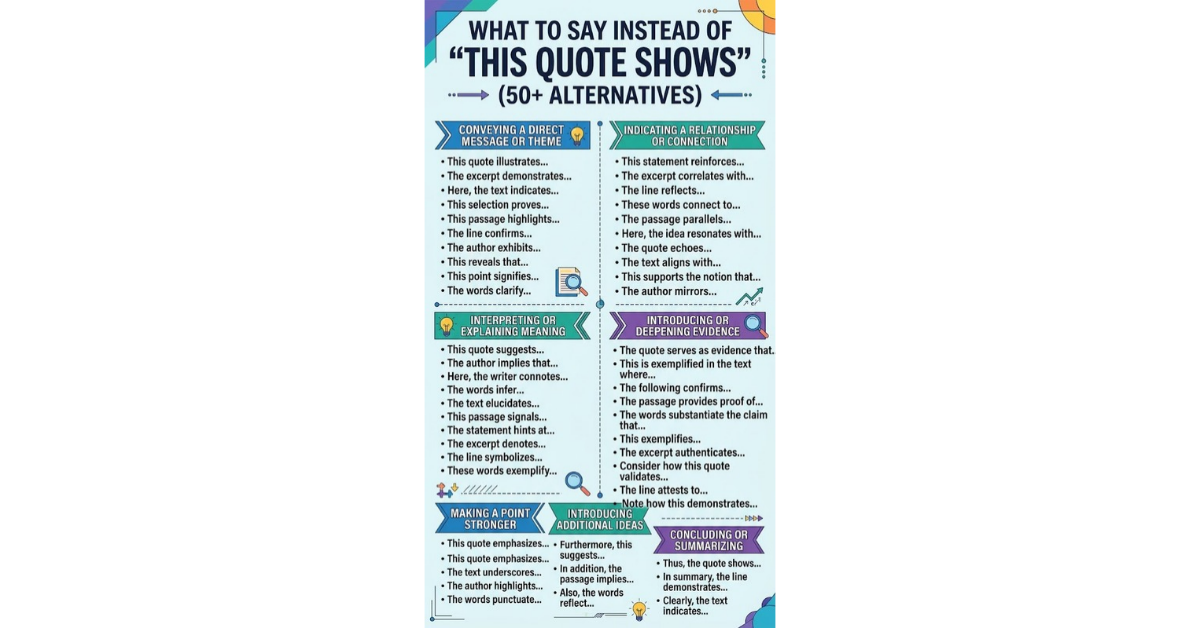
What to Say Instead of “This Quote Shows”
The easiest way to improve your writing is to replace the general verb shows with a more precise word that explains what the quotation contributes to your argument.
Here are some useful alternatives:
- This quote reveals that…
- This passage suggests that…
- These words demonstrate that…
- This statement highlights…
- This quotation illustrates…
- This evidence indicates that…
- This excerpt emphasizes…
- This line implies that…
- This passage reinforces the idea that…
- This quotation supports the argument that…
- The speaker’s words convey…
- This statement reflects…
- This excerpt underscores…
- This line exposes…
- This evidence establishes…
- The quotation points to…
- This passage draws attention to…
- These words make clear that…
- The author’s language suggests…
- This example demonstrates…
Each alternative carries a slightly different meaning. Choosing the right one makes your explanation more specific and helps readers understand why the quotation matters.
Formal Alternatives to “This Quote Shows”
If you’re writing a college essay, research paper, literary analysis, or other academic assignment, a more formal expression may strengthen your discussion.
Consider these options.
1. This Quotation Demonstrates
Use this phrase when the evidence provides a clear example of an idea or supports a conclusion.
Example:
Original: This quote shows that the character is brave.
Improved: This quotation demonstrates the character’s courage in the face of danger.
2. This Passage Illustrates
Use illustrates when a quotation provides a concrete example of a broader concept.
Example:
This passage illustrates how social expectations influence the character’s decisions.
3. This Evidence Supports
This phrase works particularly well in argumentative and research-based writing.
Example:
This evidence supports the argument that access to education can improve economic opportunities.
4. This Statement Establishes
Use establishes when the quotation helps set up an important point or provides a foundation for further analysis.
Example:
This statement establishes the central conflict between personal ambition and family responsibility.
5. This Excerpt Highlights
Choose highlights when a quotation draws attention to a particular detail, issue, or idea.
Example:
This excerpt highlights the inequality experienced by the novel’s working-class characters.
6. This Quotation Underscores
Underscores is useful when the quotation strengthens or emphasizes an important point.
Example:
This quotation underscores the importance of trust in maintaining meaningful relationships.
7. This Passage Reinforces
Use reinforces when a quotation strengthens an idea that has already been introduced.
Example:
This passage reinforces the author’s criticism of social prejudice.
Analytical Alternatives for Literary Essays
Literary analysis requires more than identifying what a quotation says. You also need to explain what it reveals about characters, themes, symbolism, tone, or the author’s purpose.
These alternatives can help you move beyond simple description.
| Alternative phrase | Best use |
| This reveals… | Exposing a hidden quality or truth |
| This suggests… | Presenting a reasonable interpretation |
| This implies… | Explaining an indirect meaning |
| This symbolizes… | Interpreting symbolic meaning |
| This reflects… | Connecting a detail to a larger idea |
| This conveys… | Explaining a feeling, message, or attitude |
| This foreshadows… | Identifying a hint about future events |
| This characterizes… | Explaining how a character is presented |
| This reinforces the theme of… | Connecting evidence to a recurring idea |
| This exposes… | Revealing a problem, flaw, or injustice |
| This complicates… | Showing that an idea is more complex than it first appears |
| This contrasts with… | Identifying an important difference |
| This emphasizes… | Drawing attention to a particular point |
| This alludes to… | Identifying a reference to another text, event, or idea |
| This reflects the author’s view of… | Connecting a passage to a broader perspective |
Example: Analyzing a Character
Weak: This quote shows that the character is lonely.
Stronger: The character’s repeated references to silence reveal a deep sense of isolation.
The improved version identifies the specific evidence and explains what it suggests about the character.
Example: Analyzing a Theme
Weak: This quote shows the theme of freedom.
Stronger: The speaker’s determination to make independent choices reinforces the novel’s theme of personal freedom.
The second sentence connects the quotation to a broader literary idea rather than simply naming the theme.
Example: Analyzing Symbolism
Weak: This quote shows that the storm is important.
Stronger: The storm symbolizes the emotional turmoil that threatens to overwhelm the protagonist.
The stronger sentence interprets the symbol and explains its significance.
Alternatives to “This Quote Shows” for Argumentative Essays
In persuasive writing, quotations should support your claims and help readers understand your reasoning.
Instead of repeatedly writing this quote shows, choose language that explains how the evidence relates to your argument.
Useful alternatives include:
- This evidence supports the claim that…
- This statement strengthens the argument that…
- The author’s words substantiate the idea that…
- This example provides evidence that…
- The quotation lends support to the position that…
- This finding suggests that…
- This evidence challenges the assumption that…
- The passage calls into question…
- This example illustrates why…
- These findings reinforce the argument that…
- This evidence points to…
- The statement provides a basis for concluding that…
Example of Argumentative Writing
Weak: This quote shows that school uniforms improve student discipline.
Improved: This evidence supports the argument that school uniforms may encourage a more consistent learning environment.
Notice the word may. It avoids claiming that the evidence proves a universal result when the quotation might support only a limited conclusion.
For academic writing, your wording should reflect the actual strength of the evidence.
Simple and Natural Alternatives for Everyday Writing
Not every essay needs highly formal language. If you’re writing a high school assignment or want your explanation to sound natural, straightforward phrases can work very well.
Try these alternatives:
- This means that…
- This makes it clear that…
- This helps explain why…
- This gives an example of…
- This points out that…
- This tells us that…
- This helps the reader understand…
- This makes the idea clearer…
- This gives us a better understanding of…
- This helps explain the author’s point.
- This is an example of…
- This connects to the idea that…
Example
Original: This quote shows that the character misses her family.
Natural alternative: This helps the reader understand how much the character misses her family.
The revised sentence sounds conversational while still explaining the quotation’s meaning.
Alternatives to “This Quote Shows” for Different Purposes
The best replacement depends on the point you want to make. Use this quick reference to select a phrase that fits your analysis.
| If you want to… | Try saying… |
| Reveal a hidden truth | This reveals… |
| Explain a possible meaning | This suggests… |
| Make a clear point | This demonstrates… |
| Emphasize an idea | This underscores… |
| Support a claim | This evidence supports… |
| Explain an emotion | This conveys… |
| Discuss a theme | This reinforces the theme of… |
| Explain a symbol | This symbolizes… |
| Show a contradiction | This challenges… |
| Compare two ideas | This contrasts with… |
| Explain an author’s purpose | The author uses this to… |
| Discuss a character | This characterizes… |
| Identify a future hint | This foreshadows… |
| Connect to a larger issue | This reflects… |
| Explain a consequence | This illustrates how… |
This approach helps you select words based on meaning instead of choosing a synonym at random.
How to Explain a Quote Without Saying “This Quote Shows”
One of the best ways to improve your essay is to stop treating quotation analysis as a fill-in-the-blank exercise.
Instead of automatically writing this quote shows, use a simple three-step method.
Step 1: Identify the Main Idea
Ask yourself what the quotation communicates.
Does it reveal a character’s fear? Support your thesis? Illustrate a theme? Challenge an assumption?
For example, imagine a character says:
“I would rather lose everything than surrender my freedom.”
The main idea is that the character values freedom more than material security.
Step 2: Choose a Precise Analytical Verb
Select a verb that captures the quotation’s purpose.
In this case, reveals, demonstrates, or emphasizes could work.
Step 3: Explain Why It Matters
Connect the quotation to the larger point of your essay.
Improved analysis:
The character’s declaration reveals that personal freedom matters more to them than material security, reinforcing the story’s broader conflict between independence and social expectations.
This sentence does three things: interprets the quotation, explains the character’s priorities, and connects the evidence to a larger theme.
That is more effective than simply stating that the quotation shows the character values freedom.
How to Integrate Quotes Into an Essay
Finding a good alternative phrase is only part of the process. You also need to introduce quotations naturally and explain their relevance.
A useful structure is:
Claim + Quotation + Analysis
For example:
Claim: The protagonist struggles to trust others.
Quotation: The narrator explains, “She kept every promise at a distance, afraid of what it might cost her.”
Analysis: The narrator’s description suggests that the protagonist associates emotional commitment with potential loss, revealing how fear influences her relationships.
In a finished essay, these elements can be combined into a smooth paragraph.
The key is to make the quotation part of your reasoning rather than leaving it to speak for itself.
Avoid Dropping Quotes Into Your Writing
A quotation without an introduction or explanation can leave readers wondering why it matters.
Instead of writing:
“She kept every promise at a distance, afraid of what it might cost her.”
Follow it with an interpretation that connects the passage to your argument.
For example:
The narrator’s description suggests that the protagonist fears emotional vulnerability, which helps explain why she struggles to form lasting relationships.
You do not always need a phrase such as this quote shows. Sometimes, you can begin your analysis directly with the subject of the quotation.
Common Mistakes to Avoid When Analyzing Quotes
Even a strong quotation can lose its impact if your explanation is vague or repetitive.
1. Repeating the Same Phrase
Using this quote shows several times in one paragraph makes your writing sound predictable.
Better approach: Alternate between precise analytical verbs and direct explanations.
2. Restating the Quotation
Simply repeating the quotation’s meaning does not provide much analysis.
Weak: This quote shows that the character is afraid because she says she is scared.
Better: The character’s admission of fear reveals her vulnerability and suggests that uncertainty is preventing her from taking action.
3. Making Claims the Evidence Cannot Support
A quotation may suggest an interpretation without proving it conclusively.
Use suggests, implies, or points to when the meaning is open to interpretation. Reserve stronger terms such as demonstrates or establishes for evidence that clearly supports your claim.
4. Using Complicated Words Unnecessarily
Words such as elucidates or substantiates can be useful in the right context, but they are not automatically better than simpler alternatives.
Choose language that communicates your point clearly.
5. Forgetting to Connect the Quote to Your Thesis
A good analysis explains not only what the quotation means but also why it matters to your overall argument.
After interpreting the evidence, ask yourself: How does this help prove my main point?
Frequently Asked Questions
What is the best alternative to “this quote shows”?
There is no single best alternative for every situation. “This reveals” works well for character analysis, “this suggests” is useful for interpretations, and “this evidence supports” is effective in argumentative essays.
What can I say instead of “this quote shows” in an essay?
You can write “this passage demonstrates,” “the quotation reveals,” “this evidence supports,” or “the author’s words emphasize.” Choose the phrase that best explains how the quotation relates to your argument.
How do you analyze a quote without repeating yourself?
Use a variety of analytical verbs, explain the significance of specific words, and connect each quotation to a different part of your argument. You can also begin sentences with the character, author, theme, or idea being discussed instead of referring to the quotation every time.
Is “this quote demonstrates” better than “this quote shows”?
It can be more precise in formal writing, particularly when the quotation clearly illustrates a point. However, shows is not grammatically incorrect. The goal is to choose a verb that accurately represents what the evidence does.
What is a more academic way to say “this shows”?
Depending on the context, try “this demonstrates,” “this indicates,” “this reveals,” “this underscores,” or “this provides evidence that.” For literary analysis, reveals and suggests are often especially useful.
What can I say instead of “this quote proves”?
Try “this evidence supports,” “this suggests,” or “this strengthens the argument that.” The word proves can overstate what a quotation establishes, especially when the evidence allows more than one interpretation.
Can I use “this suggests” in a literary analysis essay?
Yes. This suggests is particularly appropriate when interpreting a character’s behavior, symbolism, imagery, or an author’s implied message. It allows you to present a reasoned interpretation without claiming that it is the only possible reading.
How do I explain why a quote is important?
Identify the quotation’s meaning, explain what it reveals or supports, and connect it to your thesis or the text’s larger themes. A strong explanation answers the question, “So what?” rather than simply repeating what the author said.
Should I use “quote,” “quotation,” or “passage”?
All three can be correct, but they are not always interchangeable. Quote is common in everyday writing, quotation often sounds more formal, and passage usually refers to a longer section of text.
Is it okay to start a sentence with “this quote shows”?
Yes. The phrase is grammatically acceptable, and it can be suitable for basic explanations. However, varying your wording and offering a more specific interpretation can make an essay more engaging and analytical.
Conclusion
Learning what to say instead of “this quote shows” is a simple way to improve your academic writing. Alternatives such as this reveals, this suggests, this demonstrates, this underscores, and this evidence supports help you explain quotations more precisely and avoid repetitive sentence structures.
The most important thing is not to replace one phrase with a more complicated synonym just for the sake of sounding academic. Instead, choose words that accurately describe the evidence and explain why it matters.
The next time you analyze a quotation, identify its main idea, select a precise analytical verb, and connect the evidence to your argument. With practice, your writing will become clearer, more persuasive, and more insightful.