Have you ever stopped while writing an email or report to wonder whether headcount or head count is the correct spelling? You’re not alone. Both forms appear in English writing, and deciding whether to use one word or two can be confusing, especially in business, human resources, and everyday communication.
The good news is that both “headcount” and “head count” are acceptable English spellings. The closed form, headcount, is especially common in modern business writing, while head count remains an established alternative. The best choice depends on the context, your preferred style guide, and whether you’re referring to the number of people or the act of counting them.
Let’s explore the difference, examine practical examples, and explain how to use each form correctly.
Headcount or Head Count: Which Is Correct?
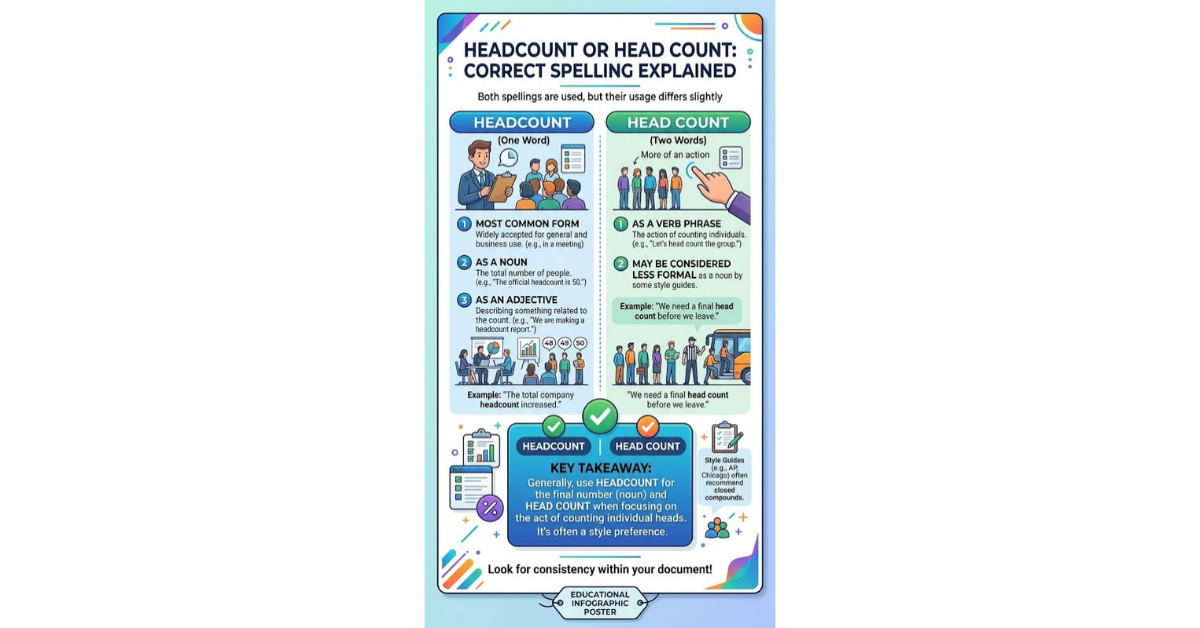
Both headcount and head count are correct. Unlike spelling pairs in which one form is a clear mistake, this is a compound-word variation.
A compound word combines two words to express a single concept. English compounds can appear in three main forms:
- Closed compound: headcount
- Open compound: head count
- Hyphenated compound: head-count
The closed and open forms are both established. The hyphenated version is less common in general usage and is usually unnecessary unless a particular style guide or sentence structure calls for it.
In professional settings, headcount is widely used when discussing staffing levels, employee numbers, hiring plans, and workforce budgets.
Examples:
- The company’s headcount increased by 15 employees.
- The company’s head count increased by 15 employees.
Both sentences communicate the same idea. However, consistency matters: if your organization uses headcount in official reports, it is sensible to follow that convention throughout the document.
What Does Headcount Mean?
Headcount refers to the number of people in a group, organization, team, or location. It can also refer to the process of counting people to determine how many are present.
The word is particularly common in human resources, business management, education, event planning, and operations.
For example:
- A business might track its employee headcount to monitor workforce growth.
- A teacher might perform a head count before a school trip.
- An event organizer might confirm the headcount before ordering food.
- A manager might review department headcount before approving new hires.
Although the spelling varies, the underlying meaning remains essentially the same.
Headcount vs. Head Count: Is There a Difference in Meaning?
In most situations, there is no meaningful difference in meaning between headcount and head count. Both can refer to the number of people or the act of counting them.
However, usage preferences may differ depending on the context.
Headcount in Business and HR
The one-word form is particularly common in business terminology.
Examples include:
- Employee headcount
- Headcount planning
- Headcount reduction
- Headcount growth
- Headcount budget
- Headcount report
In these expressions, headcount functions as a standard business term.
For instance:
“Our headcount increased from 120 to 135 employees this year.”
This means the organization now employs 135 people, compared with 120 previously.
Head Count in Everyday English
The two-word form is also widely used, particularly when describing the act of counting people.
Examples include:
- Please take a head count before we leave.
- The teacher performed a head count after lunch.
- We need a final head count for the dinner reservation.
The open form is not incorrect in these examples. Many writers use it naturally in everyday English.
Does Context Determine Which Form to Use?
Context can influence which spelling feels most natural, but it does not create an absolute grammatical distinction.
For example, headcount is a common choice for a company’s staffing total, while head count is often used in phrases describing a physical count of people. Both forms can work in either context.
The most practical approach is to choose the spelling that fits your organization’s style and use it consistently.
Headcount in Business and Human Resources
In the workplace, headcount usually refers to the number of employees an organization or department has.
It is an important metric because staffing levels affect payroll expenses, productivity, hiring decisions, and operational planning.
1. Employee Headcount
Employee headcount is the total number of employees in an organization or a particular department.
For example, a company with 80 full-time employees and 20 part-time employees may report a headcount of 100 if both groups are included in its count.
The exact number can depend on the organization’s reporting rules, particularly when contractors, temporary workers, and other nonemployee workers are involved.
2. Headcount Planning
Headcount planning involves determining how many employees a business needs to meet its goals.
Managers and HR professionals may consider:
- Current staffing levels
- Expected business growth
- Employee turnover
- Hiring requirements
- Payroll budgets
- Department workloads
- Future operational needs
Effective planning helps companies avoid unnecessary staffing costs while ensuring teams have enough people to complete their work.
3. Headcount Reduction
A headcount reduction occurs when the number of employees decreases.
This may happen because of resignations, retirements, hiring freezes combined with employee departures, restructuring, or layoffs.
For example:
“The company announced a headcount reduction as part of its restructuring plan.”
The phrase describes a reduction in the number of employees, not necessarily a specific reason for that reduction.
4. Headcount Growth
Headcount growth refers to an increase in the number of employees.
For instance, a startup might grow from 25 employees to 40 as it expands into new markets.
Businesses often track headcount growth alongside revenue, productivity, and operating expenses to evaluate whether staffing levels are appropriate.
How to Use Headcount or Head Count in a Sentence
The easiest way to understand the spelling is to see it used in different situations.
Business Examples
- The company plans to increase its headcount next year.
- Our department’s head count has remained stable.
- HR reviews headcount figures every quarter.
- The manager requested approval for additional headcount.
- The organization reduced its headcount following a restructuring.
Everyday Examples
- Please take a head count before boarding the bus.
- We need an accurate head count for the wedding.
- The teacher completed a head count before leaving the classroom.
- The final headcount for the meeting is 35 people.
- The event coordinator confirmed the head count with the catering team.
Notice that both forms appear naturally in these sentences. Neither spelling should automatically be treated as a grammatical error.
Headcount vs. Head Count vs. Head-Count
These three forms can look similar, but their usage frequency differs.
| Spelling | Status | Typical usage |
| Headcount | Correct | Common in business, HR, and staffing terminology |
| Head count | Correct | Common in everyday writing and counting people |
| Head-count | Less common | Generally unnecessary unless a style convention requires it |
The hyphenated form is not usually needed when the word is used as a noun.
For most business reports and general writing, headcount or head count will be the better choice.
Is Headcount One Word or Two?
The answer is that it can be either one word or two.
Headcount is a closed compound, meaning the words head and count are joined together. Head count is an open compound, meaning the two words remain separate.
Both forms are established in English, and neither is inherently wrong.
If you’re writing a professional report, however, the one-word form is a practical choice because it is widely recognized in business and HR terminology.
For example:
Preferred in many business contexts:
“The company’s headcount is expected to reach 500 employees.”
Also correct:
“The company’s head count is expected to reach 500 employees.”
How Is Headcount Different From FTE?
In business writing, headcount is sometimes confused with FTE, or full-time equivalent. Although the two measures are related, they are not interchangeable.
Headcount measures the number of individual people included in a count.
FTE measures workload or staffing capacity relative to a full-time work schedule.
Consider a company with four employees:
- Two full-time employees working 40 hours per week
- Two part-time employees working 20 hours per week
The company has a headcount of four. Assuming 40 hours represents one full-time schedule, its combined staffing capacity is three FTEs.
This distinction matters when organizations compare staffing costs, productivity, and labor requirements. Always check how a company defines its reporting metrics before comparing figures.
Common Mistakes When Using Headcount
Although the spelling itself is flexible, several usage mistakes are worth avoiding.
Mistake 1: Treating Head Count as Incorrect
Incorrect assumption: “Head count is always wrong because headcount must be one word.”
Better understanding: Both forms are accepted. Follow the relevant style guide or organizational convention.
Mistake 2: Confusing Headcount With Full-Time Employees
A headcount figure does not automatically mean the same thing as the number of full-time employees.
Depending on the reporting rules, the total might include part-time employees or exclude contractors and temporary workers.
Mistake 3: Using Inconsistent Spellings
Switching between headcount and head count several times in the same report can make the writing appear inconsistent.
Choose one form and use it throughout the document unless there is a specific reason to do otherwise.
Mistake 4: Assuming Headcount Always Means Employees
The term can refer to employees, but it can also describe the number of people attending an event, joining a meeting, or belonging to a group.
For example, “The final headcount for the conference is 250” refers to the number of people expected to attend.
Frequently Asked Questions
Is headcount one word or two?
Both headcount and head count are correct. The one-word form is particularly common in business and HR writing, while the two-word form is also widely accepted.
Is headcount or head count preferred in business writing?
Headcount is a common choice in business writing, particularly for employee totals, workforce planning, and staffing budgets. However, the open form is also acceptable, so follow your organization’s style guide.
Is head-count hyphenated?
Usually, no. The standard choices are headcount and head count. The hyphenated form is less common and generally unnecessary unless a particular style guide requires it.
What does headcount mean in HR?
In human resources, headcount refers to the number of employees in an organization, department, or team. Companies use it to monitor staffing levels, plan recruitment, and manage workforce costs.
What is the difference between headcount and FTE?
Headcount counts individual people, while FTE measures staffing capacity based on full-time working hours. A group of part-time employees can have a higher headcount than its total FTE figure.
Is headcount a formal word?
Yes. Headcount is an established term used in professional, business, financial, and HR writing. It is suitable for workplace reports, presentations, and staffing discussions.
What is the plural of headcount?
The plural is generally headcounts when referring to multiple counts or separate staffing totals.
For example: “The HR team compared the headcounts of three departments.”
When referring to the number of employees in one organization, writers often use headcount as a general metric: “Our headcount increased this year.”
Can headcount refer to people attending an event?
Yes. Headcount can refer to the number of attendees at a meeting, conference, wedding, or other gathering. For example, “Please confirm the headcount before we finalize the catering order.”
Conclusion: Headcount or Head Count?
When choosing between headcount or head count, remember that both spellings are correct. The closed form is particularly common in business and human resources, while the open form remains a natural and accepted alternative in everyday English.
If you’re writing a company report, employee staffing plan, or HR document, headcount is a practical default. If you prefer head count, that is acceptable too. The key is to use the spelling consistently and make sure the meaning is clear.
Understanding this small difference can help you write more confidently, whether you’re preparing a professional report, organizing an event, or simply checking your grammar. For more useful spelling comparisons and English usage tips, explore related grammar guides and keep building your writing skills.