Have you ever seen someone write “I ironically love this song” or “I unironically think this movie is amazing” and wondered what they actually meant? The difference between ironically vs unironically can be confusing, especially because these words often appear in social media posts, memes, online discussions, and everyday conversations.
Although the two words look similar, they communicate different attitudes toward what someone says or does. Ironically often signals irony, a contrast between the literal meaning and the intended meaning, or a situation that contradicts expectations. Unironically means sincerely or genuinely, without intending irony.
Understanding the distinction helps you interpret messages more accurately, avoid misunderstandings, and express yourself more clearly. Let’s explore what each word means, how to use it correctly, and why both have become so common in internet culture.
Ironically vs Unironically: What’s the Difference?
The main difference between ironically and unironically is whether someone intends to communicate irony or is being sincere.
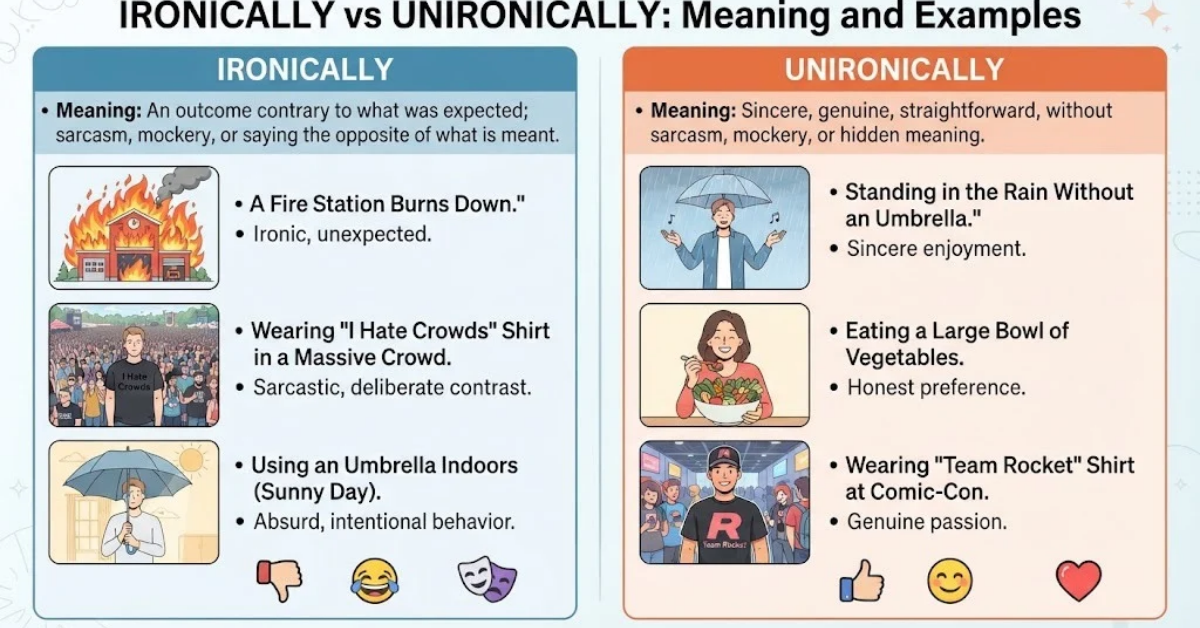
- Ironically: In a way that involves irony, such as expressing something different from what is literally meant or highlighting an unexpected contradiction.
- Unironically: In a sincere or genuine way, without intending irony or sarcasm.
Consider these examples:
Ironically:
I ironically listen to cheesy pop songs when I’m trying to look sophisticated.
This suggests that the person enjoys the songs in a way that involves humor, self-awareness, or a contrast with their intended image.
Unironically:
I unironically listen to cheesy pop songs because I genuinely love them.
Here, the person enjoys the music sincerely. They are not presenting their enjoyment as a joke or a form of mockery.
In everyday conversation, the distinction often comes down to sincerity. However, ironically has several meanings, so context is essential.
What Does Ironically Mean?
Ironically is an adverb derived from the word ironic. It describes something involving irony, whether in speech, writing, behavior, or circumstances.
Irony often involves a contrast between what is expected and what happens, what is said and what is meant, or what someone appears to believe and what they actually believe.
There are several common forms of irony.
1. Verbal Irony
Verbal irony occurs when someone says something different from, or contrary to, what they genuinely mean.
For example:
Someone gets completely soaked in a rainstorm and says, “Well, this is wonderful weather!”
The speaker probably does not believe the weather is wonderful. The comment communicates frustration through an ironic contrast.
Verbal irony can overlap with sarcasm, although sarcasm is often more pointed or mocking.
2. Situational Irony
Situational irony occurs when the outcome of an event contrasts with what people reasonably expect.
For example:
A fire station catches fire.
The unexpected contradiction makes the situation ironic.
Another example is a professional organizer losing track of their own appointment calendar. The humor comes from the mismatch between the person’s role and the outcome.
3. Dramatic Irony
Dramatic irony occurs when the audience knows something that a character does not.
For instance, in a suspense movie, viewers might know that a character’s house is being watched while the character believes they are completely safe.
The difference between the audience’s knowledge and the character’s understanding creates dramatic irony.
How Is “Ironically” Used in Everyday Speech?
In casual conversation, people often use ironically more loosely than they do in literary analysis.
Examples include:
- “I ironically bought a T-shirt with a terrible slogan because it made me laugh.”
- “He plays that cheesy song ironically at parties.”
- “Ironically, the person who hates technology became the company’s IT manager.”
- “I started watching the show as a joke, but now I’m hooked.”
Notice that the final example may describe an unexpected change rather than deliberate sarcasm. The precise meaning depends on the situation.
What Does Unironically Mean?
Unironically means sincerely, genuinely, or without intending irony. It emphasizes that a statement or preference should be taken at face value rather than interpreted as a joke or sarcastic remark.
People often use this word when they expect others might assume they are joking.
For example:
I unironically love that old-fashioned restaurant.
The speaker genuinely enjoys the restaurant, even if other people consider it outdated or unfashionable.
Here are a few more examples:
- “I unironically think this is one of the best albums ever made.”
- “She unironically enjoys watching the same movie every weekend.”
- “I unironically believe that handwritten letters are more meaningful than texts.”
- “He unironically wears colorful socks with every outfit.”
- “I unironically love this ridiculous-looking character.”
In each example, the speaker is emphasizing genuine appreciation rather than making fun of the subject.
Why Do People Say “Unironically”?
People often use unironically when expressing an opinion that might otherwise be mistaken for a joke.
Imagine someone praising a movie that is widely considered poorly made. Their friends might assume the praise is sarcastic or that the person enjoys the movie because it is unintentionally funny.
Saying, “I unironically love this movie,” clarifies that the affection is genuine.
The word can also communicate confidence. A person may acknowledge that their taste is unusual without feeling the need to disguise it as humor.
Ironically vs Unironically Examples in Everyday Conversations
The easiest way to understand the difference is to compare the words in similar situations.
| Situation | Ironically | Unironically |
| Music | “I listen to this song ironically because it’s so cheesy.” | “I unironically love this song.” |
| Movies | “I watch these terrible movies ironically.” | “I unironically think this movie is brilliant.” |
| Fashion | “He wears that ridiculous hat ironically.” | “She unironically loves wearing oversized hats.” |
| Food | “I bought this novelty snack ironically.” | “I unironically enjoy this unusual flavor.” |
| Social media | “I posted that ridiculous quote ironically.” | “I unironically agree with that quote.” |
| Humor | “He ironically praised the terrible performance.” | “He unironically praised the performance because he thought it was excellent.” |
These examples illustrate the general contrast, but the words do not always describe mutually exclusive situations. Someone can genuinely enjoy something while also recognizing its humor or absurdity.
Example 1: Music
Ironically:
“I listen to this cheesy song ironically because the lyrics are ridiculous.”
The listener is highlighting the song’s silliness as part of the experience.
Unironically:
“I unironically listen to this cheesy song because it makes me happy.”
The listener enjoys the song for its own sake.
Example 2: Movies
Ironically:
“I watch this terrible action movie ironically because the special effects are hilarious.”
Unironically:
“I unironically think this action movie is fantastic.”
The first person emphasizes amusement at the movie’s flaws. The second expresses genuine admiration.
Example 3: Fashion
Ironically:
“He wears those oversized sunglasses ironically because he thinks they look absurd.”
Unironically:
“He unironically loves those oversized sunglasses and wears them everywhere.”
The difference is whether the unusual fashion choice is being presented as a joke or a genuine preference.
Example 4: Online Opinions
Ironically:
“I ironically posted that motivational quote because it sounded exaggerated.”
Unironically:
“I unironically believe that quote offers good advice.”
The first statement suggests humor or deliberate exaggeration. The second communicates sincere agreement.
Ironically vs Unironically on Social Media
The distinction has become especially noticeable on platforms such as TikTok, Reddit, Instagram, YouTube, and X.
Online, people frequently use humor, exaggerated opinions, memes, and deliberately awkward content. As a result, it can be difficult to tell whether a person genuinely likes something or is joking about liking it.
The words ironically and unironically help establish the intended tone.
What Does “Unironically” Mean in Internet Slang?
In internet slang, unironically often means “I genuinely mean this, even if it sounds ridiculous.”
For example:
This cartoon has no business being that good. I unironically love it.
The speaker is emphasizing sincere enjoyment, perhaps because the cartoon seems childish or silly to other people.
Another example:
Unironically, this might be the best purchase I’ve ever made.
Here, the speaker wants readers to understand that the praise is genuine, not sarcastic.
What Does “Ironically” Mean in Memes?
In meme culture, ironically can describe sharing or enjoying something because it is awkward, exaggerated, outdated, absurd, or unintentionally funny.
For example:
I started using this old meme ironically, and now it’s my entire personality.
The joke is that something originally used for amusement has gradually become part of the person’s genuine behavior or preferences.
This shift can blur the line between irony and sincerity. Someone might begin enjoying something as a joke and eventually develop a real attachment to it.
What Is Post-Irony?
Post-irony describes a style of expression in which irony and sincerity become difficult to separate.
A person might make a statement that sounds deliberately ridiculous but also reflects a genuine belief. Alternatively, they might express a sincere opinion in such an exaggerated way that the audience cannot tell whether it is a joke.
For example:
This is the greatest movie ever made, and I will defend it with my life.
Depending on the speaker and context, this could be an ironic exaggeration, a sincere expression of enthusiasm, or both.
Post-ironic humor is one reason online conversations can be difficult to interpret without knowing the speaker’s personality or the context of the discussion.
Ironically vs Unironically: Are They Opposites?
In many everyday situations, ironically and unironically function as contrasting terms.
- Ironically signals an ironic attitude or an ironic relationship between meaning and circumstances.
- Unironically explicitly denies that the intended meaning is ironic.
However, they are not perfect opposites in every context.
The word ironically can describe an unexpected event, as in “Ironically, the only person who forgot the meeting was the one who organized it.” In that sentence, the speaker is describing an ironic coincidence, not necessarily making an insincere statement.
Meanwhile, unironically generally emphasizes sincerity or the absence of an ironic intention.
Therefore, it is helpful to consider what the sentence is describing before deciding whether the two words are opposites.
How to Use Ironically and Unironically Correctly
Choosing the right word becomes easier when you identify the message you want to communicate.
Use “Ironically” When You Mean:
- A statement is intended to be ironic.
- Someone says something that contrasts with what they genuinely mean.
- An event produces an unexpected or contradictory result.
- A person engages with something partly for its humor or absurdity.
Examples:
- “Ironically, the traffic officer received a parking ticket.”
- “She jokingly praised the awful service ironically.”
- “I bought the shirt ironically because the design was so ridiculous.”
The second example is somewhat repetitive in ordinary writing. A cleaner version would be, “She ironically praised the awful service.”
Use “Unironically” When You Mean:
- You genuinely believe something.
- You sincerely enjoy something.
- You are not making a sarcastic or ironic statement.
- You want to clarify that an unusual opinion is authentic.
Examples:
- “I unironically love old romantic comedies.”
- “He unironically thinks the book deserves more recognition.”
- “I unironically believe that taking breaks makes me more productive.”
A Simple Test
Before using either word, ask yourself:
Am I emphasizing irony, or am I emphasizing sincerity?
If you want to highlight irony, ironically may fit. If you want to clarify that you genuinely mean what you say, unironically is usually the better choice.
Common Mistakes When Using Ironically and Unironically
Even though both words are common, they are sometimes used imprecisely.
Mistake 1: Assuming “Ironically” Always Means “Sarcastically”
Irony and sarcasm overlap, but they are not identical.
Sarcasm often involves mockery, criticism, or a sharp tone. Irony is broader and can involve unexpected outcomes, contrasts, or indirect meanings without intending to insult anyone.
For example:
“Ironically, the bakery ran out of bread” describes an unexpected contradiction. It is not necessarily sarcastic.
Mistake 2: Assuming “Unironically” Means “Seriously”
The two words can overlap, but unironically specifically emphasizes the absence of irony.
For example, “I seriously need a vacation” expresses urgency. “I unironically love this ridiculous song” clarifies that the affection is genuine rather than ironic.
Mistake 3: Using “Ironically” When You Mean “Coincidentally”
The words sometimes overlap in casual conversation, but they are not interchangeable in every sentence.
For instance:
“Ironically, the person who taught the class failed the final exam” emphasizes a contradiction.
“Coincidentally, I met my old teacher at the airport” describes an unexpected meeting without necessarily suggesting irony.
Use coincidentally when you simply mean that two events happened by chance.
Mistake 4: Overusing “Unironically” in Everyday Writing
Although unironically is useful, it is not necessary whenever you express an opinion.
Instead of writing, “I unironically think this restaurant is excellent,” you can simply say, “I think this restaurant is excellent.”
Use unironically when the distinction between sincerity and irony matters.
Ironically vs Unironically in Formal Writing
Both words are legitimate English adverbs, but their suitability depends on the context.
Ironically is common in literature, journalism, essays, commentary, and everyday conversation. It can describe rhetorical techniques, unexpected events, or contradictions.
Unironically is also grammatically correct, but it appears especially often in informal conversation and internet culture. In formal writing, words such as sincerely, genuinely, or without irony may communicate the intended meaning more precisely.
Compare these examples:
Informal:
“I unironically think the old version is better.”
More formal:
“I genuinely believe the previous version is better.”
Similarly:
Informal:
“Ironically, the committee rejected the proposal intended to simplify its procedures.”
Formal and precise:
“Unexpectedly, the committee rejected the proposal intended to simplify its procedures.”
The second formal example is appropriate if the emphasis is on an unexpected outcome rather than irony itself.
Synonyms for Ironically and Unironically
Knowing related words can help you express your meaning more precisely.
Synonyms and Related Expressions for Ironically
Depending on the context, you might use:
- Sarcastically
- Mockingly
- In an ironic way
- With a sense of irony
- Contradictorily, when describing a contradiction
- Unexpectedly, when describing an unforeseen outcome
These terms are not exact substitutes in every sentence. For example, sarcastically usually implies a particular tone, while unexpectedly does not necessarily involve irony.
Synonyms and Related Expressions for Unironically
Depending on the intended meaning, alternatives include:
- Sincerely
- Genuinely
- Earnestly
- Seriously
- Honestly
- Without irony
- In all seriousness
For example:
“I unironically admire her work.”
can become:
“I genuinely admire her work.”
The second sentence is direct and natural, making it suitable for both casual and professional writing.
Frequently Asked Questions About Ironically vs Unironically
1. What is the main difference between ironically and unironically?
Ironically describes something involving irony, while unironically means sincerely or without intending irony. For example, enjoying a song because it is ridiculous may be ironic, while enjoying it because you genuinely like it is unironically enjoying it.
2. Does unironically mean you are serious?
Usually, yes, in the sense that you genuinely mean what you say. More precisely, unironically indicates that you are not intending irony. It does not necessarily mean that the subject itself is serious or important.
3. Does ironically mean sarcastically?
Not always. Sarcasm is one form of verbal irony, but irony can also describe unexpected circumstances or contradictions. A situation can be ironic without anyone making a sarcastic remark.
4. What does “I unironically love this” mean?
It means “I genuinely love this.” The speaker may realize that other people find the subject silly, embarrassing, unfashionable, or unusual, but their appreciation is sincere.
5. What does “ironically funny” mean?
“Ironically funny” can describe something amusing because of a contradiction, unexpected outcome, or ironic meaning. In casual speech, it can also refer to humor that depends on sarcasm, absurdity, or deliberately awkward situations.
6. Can something be both ironic and sincere?
Yes. A person can genuinely enjoy something while recognizing its absurdity or making ironic comments about it. Irony and sincerity are not always mutually exclusive, especially in online humor and post-ironic expression.
7. Is unironically a real word?
Yes. Unironically is a standard English adverb formed by adding the prefix un- to ironically. It is widely used to mean sincerely or without irony.
8. Is unironically formal or informal?
It is grammatically correct in both contexts, but it is particularly common in casual speech, social media, and internet discussions. In formal writing, genuinely, sincerely, or without irony may be more suitable depending on the sentence.
9. What is the opposite of ironically?
Unironically is often the most direct contrast when discussing whether a statement or preference is intended ironically. In other contexts, the best alternative might be literally, sincerely, or without irony, depending on the intended meaning.
10. How do you remember the difference between ironically and unironically?
Remember that the prefix un- often expresses the opposite or absence of something. Therefore, unironically emphasizes the absence of irony, while ironically indicates an ironic meaning, attitude, or circumstance.
Conclusion: Ironically vs Unironically Explained
The difference between ironically vs unironically comes down to how meaning, intention, and sincerity interact.
Ironically describes an ironic statement, attitude, or situation, often involving a contrast between expectations and reality. Unironically emphasizes genuine belief, enjoyment, or intention without irony.
For example, saying “I ironically love this terrible movie” suggests that the movie’s flaws are part of the joke. Saying “I unironically love this terrible movie” makes it clear that the affection is genuine, even if other people do not understand it.
As online conversations continue to mix humor, sarcasm, exaggeration, and sincere opinions, understanding these words can help you interpret messages more accurately. Pay attention to context, consider the speaker’s intention, and choose the word that best communicates what you actually mean.