Have you ever paused while writing an email or report because you weren’t sure whether to write take effect or take affect? You’re not alone. These expressions look almost identical, but only one is correct in standard English when you mean that a rule, decision, or change begins to operate.
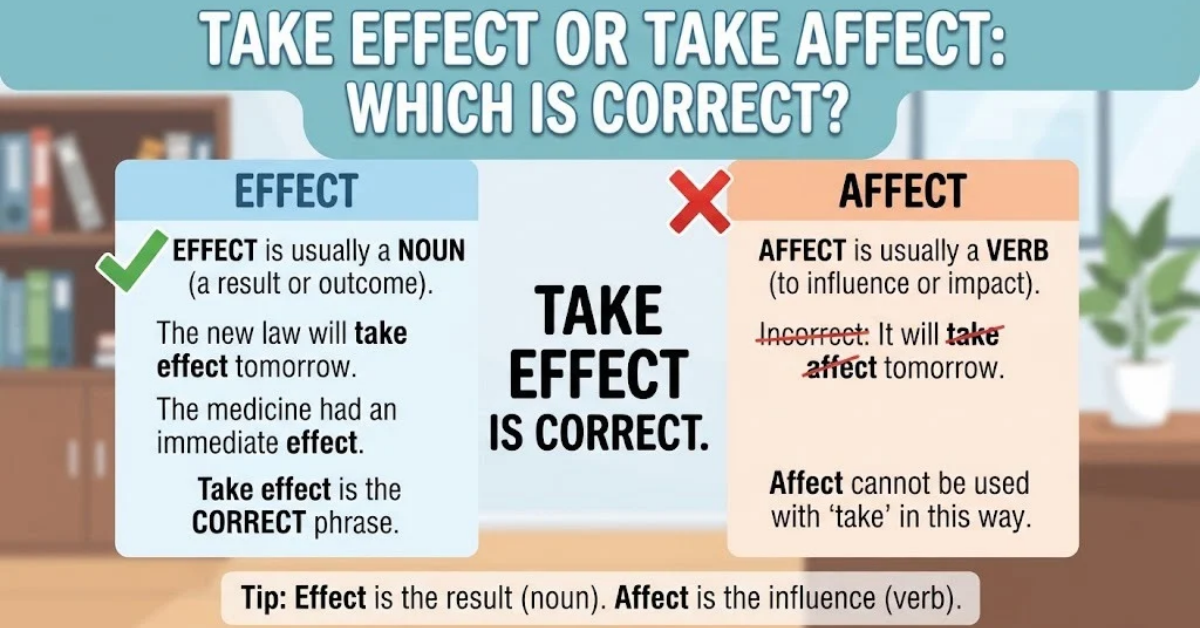
When comparing take effect or take affect, the correct phrase is take effect. It means to begin to happen, operate, or produce a result. The phrase take affect is generally a grammatical error because affect is most commonly used as a verb meaning to influence something.
Understanding this difference can help you avoid common spelling and grammar mistakes in professional emails, academic assignments, business documents, and everyday conversations.
Take Effect or Take Affect: Which Is Correct?
The correct expression is take effect, not take affect, when referring to a change, law, policy, decision, or treatment becoming active or producing results.
Here’s a quick comparison:
- Take effect: Correct phrase meaning to become active or begin to produce a result.
- Take affect: Generally incorrect when used to express the same meaning.
For example:
Correct: The new company policy will take effect on January 1.
Incorrect: The new company policy will take affect on January 1.
In the correct sentence, take effect indicates when the policy officially begins to apply.
The confusion arises because effect and affect are pronounced similarly in many varieties of English. However, their usual grammatical roles are different, which makes choosing the right word easier once you understand the basic rule.
What Does “Take Effect” Mean?
The phrase take effect means to become operative, come into force, or begin to produce a particular result.
It is commonly used when discussing something that changes a situation or begins to have an impact.
For example:
- A new law takes effect next month.
- The revised schedule will take effect on Monday.
- The medication began to take effect after an hour.
- The company’s updated rules take effect immediately.
- The agreement will take effect once both parties sign it.
In each sentence, take effect refers to something becoming active or beginning to work.
Take Effect in Everyday English
You don’t need to be discussing laws or business policies to use this expression correctly.
For instance, you might say:
“My alarm didn’t take effect because I had forgotten to turn it on.”
A more natural way to express that idea would be, “My alarm didn’t go off.” However, take effect works well when describing a process, treatment, instruction, or change that begins to operate.
Consider another example:
“The painkiller started to take effect after 30 minutes.”
Here, the phrase means that the medication began producing its intended effect. The exact time can vary depending on the medicine and the individual.
What Does “Affect” Mean?
Affect is most commonly used as a verb meaning to influence, change, or have an impact on someone or something.
For example:
- Weather conditions can affect travel plans.
- Lack of sleep may affect your concentration.
- Rising prices affect household budgets.
- The decision could affect thousands of employees.
- Stress can affect how well you sleep.
In these examples, affect describes an action: something influences or changes something else.
This is the main reason take affect is usually incorrect. When you want to say that a new rule or policy becomes active, you need the noun effect, not the verb affect.
Can “Affect” Be a Noun?
Yes, but this usage is less common outside psychology and related fields.
In psychology, affect can refer to the observable expression of emotion or emotional experience. For example, a clinical note might describe a person’s affect as calm or subdued.
However, this specialized noun meaning does not make take affect a standard alternative to take effect.
What Does “Effect” Mean?
Effect is most commonly a noun meaning a result, consequence, or change produced by an action or event.
For example:
- The new policy had a positive effect on productivity.
- Exercise can have beneficial effects on overall health.
- The storm had a serious effect on local businesses.
- The medicine produced the desired effect.
The phrase take effect follows this noun usage. It refers to a change or process becoming active or starting to produce results.
A useful way to remember the distinction is:
- Affect = influence (usually a verb).
- Effect = result (usually a noun).
This rule covers most everyday situations, although both words have less common grammatical uses.
Affect vs. Effect: What’s the Difference?
The simplest way to understand affect vs. effect is to look at how each word functions in a sentence.
| Word | Usual part of speech | Meaning | Example |
| Affect | Verb | To influence or change | Noise can affect concentration. |
| Effect | Noun | A result or consequence | Noise has an effect on concentration. |
| Take effect | Verb phrase | To become active or produce results | The new rule takes effect tomorrow. |
| Take affect | Generally incorrect phrase | Not the standard expression for becoming active | Use “take effect” instead. |
Notice the difference between these two sentences:
Affect: The new rules may affect employees.
Effect: The new rules will take effect next week.
The first sentence describes how the rules may influence employees. The second identifies when the rules begin to apply.
A Simple Memory Trick
Try this familiar grammar tip:
Affect = Action. Effect = End result.
Both affect and action begin with the letter A, which can help you remember that affect is usually a verb.
Similarly, effect and end result begin with E, making it easier to associate effect with a result or consequence.
For the phrase in question, remember:
Changes take effect. Changes affect people.
This short comparison demonstrates the difference in context.
When Should You Use “Take Effect”?
Use take effect when something begins to operate, becomes officially valid, or starts producing results.
Here are some common situations in which the expression is appropriate.
1. Laws and Regulations
Legal and regulatory writing frequently uses take effect to identify when a rule becomes applicable.
Example:
“The new traffic regulations will take effect on July 1.”
This means the regulations are scheduled to become applicable on that date. The exact legal meaning may depend on the wording of the relevant law or regulation.
2. Business Policies
Organizations use the expression when announcing changes to procedures, workplace rules, or company policies.
Example:
“The revised attendance policy will take effect at the beginning of next month.”
This tells employees when the new policy starts to apply.
3. Contracts and Agreements
The phrase can describe when an agreement becomes operative, although the precise legal conditions depend on the contract.
Example:
“The agreement will take effect after both parties have signed it.”
In formal documents, it’s important to distinguish the effective date from any conditions that must be satisfied before the agreement becomes operative.
4. Medicine and Treatments
In healthcare, take effect describes when a treatment or medication begins to produce an intended or noticeable result.
Example:
“The treatment may take several days to take effect.”
The time required varies according to the treatment and the condition being treated. The phrase describes the onset of a result, not necessarily the time required for the full benefit to develop.
5. Plans and Decisions
You can also use the expression for changes to schedules, decisions, or arrangements.
Example:
“The new timetable will take effect next Monday.”
Here, the phrase indicates when the new timetable begins to be used.
Common Mistakes With Take Effect and Affect
Even experienced writers sometimes confuse these words. The best way to avoid mistakes is to examine what you are trying to express.
Mistake 1: Writing “Take Affect”
Incorrect: The new rules will take affect tomorrow.
Correct: The new rules will take effect tomorrow.
Why? The sentence refers to when the rules become operative, so the noun effect is required.
Mistake 2: Using “Effect” When You Mean “Influence”
Incorrect: The weather may effect our travel plans.
Correct: The weather may affect our travel plans.
Why? The sentence describes the weather influencing travel plans. In ordinary usage, affect is the appropriate verb.
There is a verb effect, but it means to bring about or accomplish something, as in “effect a change.” That is a different meaning.
Mistake 3: Confusing an Effect With an Affect
Incorrect: The medication may have a positive affect on your symptoms.
Correct: The medication may have a positive effect on your symptoms.
Why? The sentence refers to a result or consequence, so the noun effect is appropriate.
Mistake 4: Confusing “Take Effect” With “Have an Effect”
Both expressions are correct, but they are used slightly differently.
- “The new law will take effect on Monday.” This identifies when the law becomes operative.
- “The new law will have an effect on businesses.” This describes the law’s influence or consequences.
Choosing between them depends on the meaning you want to communicate.
Take Effect vs. Come Into Effect vs. Go Into Effect
You may encounter several expressions that communicate a similar idea.
Take effect means to become operative or begin producing results.
Example: “The new policy takes effect tomorrow.”
Come into effect means to become operative, often in a formal or legal context.
Example: “The regulation comes into effect next month.”
Go into effect also means to become operative and is particularly common in American English.
Example: “The changes will go into effect on Monday.”
All three expressions can be correct. The best choice depends on sentence structure, regional preference, and context.
Take Effect vs. Take Place
These two expressions may appear similar, but their meanings are different.
Take effect means to become operative or start producing results.
Example: “The new policy takes effect tomorrow.”
Take place means to happen or occur.
Example: “The annual meeting will take place tomorrow.”
A policy can take effect, while a meeting takes place. Remembering this distinction will help you use both expressions accurately.
Is “Take Affect” Ever Correct?
In ordinary English, take affect is not the standard expression for a law, policy, treatment, or decision becoming active.
However, the words take and affect could appear next to each other in a different grammatical construction. For example:
“Take steps to reduce the factors that affect your sleep.”
Here, take belongs to the phrase “take steps,” while affect is a verb in a separate clause.
This is very different from saying that a policy will “take affect.”
If your intended meaning is that something becomes active or starts working, use take effect.
Frequently Asked Questions About Take Effect or Take Affect
1. Is it “take effect” or “take affect”?
The correct expression is take effect when you mean that something becomes active or starts producing results. Take affect is generally a misspelling in this context.
2. What does “take effect” mean?
“Take effect” means to become operative, come into force, or begin producing results.
Example: “The new policy will take effect on January 1.”
3. What is the difference between affect and effect?
Affect is usually a verb meaning to influence or change something. Effect is usually a noun meaning a result or consequence.
Example: “The policy may affect employees” and “The policy may have an effect on employees.”
4. Does a law take effect or take affect?
A law takes effect. This means it becomes operative or starts applying from a particular date, subject to the relevant legal provisions.
Example: “The law will take effect next month.”
5. Does medicine take effect or take affect?
Medicine takes effect when it begins to produce a noticeable or intended result.
Example: “The medicine may take effect within an hour.”
The actual onset of action depends on the medication and individual circumstances.
6. Is “come into effect” correct?
Yes. Come into effect is a standard expression meaning to become operative or start applying.
Example: “The new rules will come into effect next week.”
7. Is “go into effect” grammatically correct?
Yes. Go into effect is also correct and means to become operative. It is especially common in American English.
Example: “The updated policy goes into effect tomorrow.”
8. Can “effect” be used as a verb?
Yes. As a verb, effect means to bring about or accomplish something.
Example: “The committee hopes to effect meaningful change.”
This is different from affect, which usually means to influence something.
9. What is an easy way to remember “take effect”?
Remember this sentence: “A change takes effect, but it affects people.”
The first effect is a noun in the expression take effect. The second affects is a verb meaning influences.
10. What is the past tense of “take effect”?
The expression uses the past tense of take when describing something that became operative in the past.
Example: “The new regulations took effect last year.”
You can also say, “The medication began to take effect after 30 minutes.”
Conclusion: Remember to Take Effect, Not Take Affect
When deciding between take effect or take affect, the correct choice is almost always take effect if you mean that a change, law, policy, or treatment becomes active or begins producing results.
Remember the central distinction: affect usually means to influence, while effect usually means a result. A policy takes effect, a decision can affect people, and a change can have an effect on a situation.
With these simple rules and examples, you can avoid one of English’s common word-choice mistakes and write with greater confidence. When you’re editing your next email, assignment, or professional document, remember the phrase: Changes take effect; they affect people.