Have you ever wondered whether to write “Good morning” or “Goodmorning” when greeting someone? It might seem like a minor spelling difference, but using the correct form can make your emails, messages, and everyday communication look more polished.
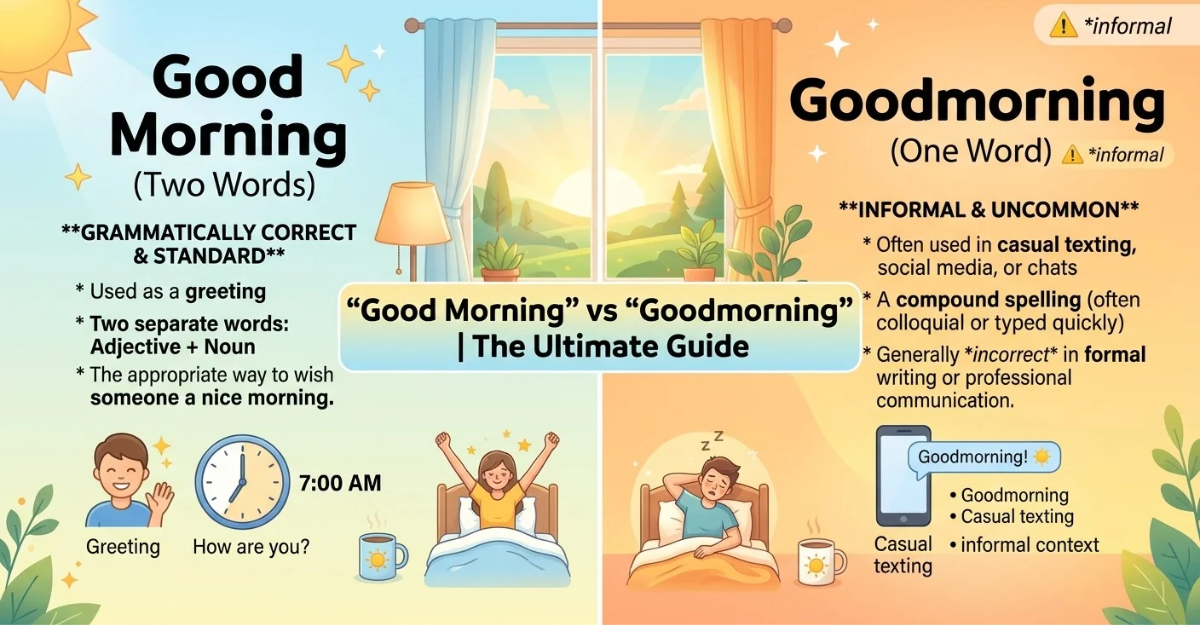
When comparing Good Morning vs Goodmorning, the correct standard English expression is “Good morning”, written as two separate words. Although people sometimes combine the words in text messages or online conversations, “Goodmorning” is not considered the standard spelling.
Understanding the difference is useful for anyone who wants to improve their English writing, avoid common grammar mistakes, and communicate confidently in professional and informal situations.
Let’s explore the meaning, spelling rules, capitalization, and practical examples to understand when and how to use this common greeting.
Is Good Morning or Goodmorning Correct?
The correct spelling is “Good morning”, with a space between the two words.
It consists of two separate words:
- Good: An adjective used to describe something positive or pleasant.
- Morning: A noun referring to the early part of the day, generally between sunrise and noon.
Together, they form a friendly greeting used when meeting someone or starting a conversation in the morning.
For example:
- Correct: Good morning! How are you today?
- Incorrect: Goodmorning! How are you today?
English spelling conventions treat the expression as an open compound rather than a single word. Therefore, combining the two words into one is generally considered a spelling mistake.
Why Is Good Morning Written as Two Words?
The reason comes down to English word formation and conventional usage.
“Good morning” is an established greeting made up of an adjective and a noun. The adjective “good” describes the kind of morning someone is wishing for another person.
Unlike certain compound words that eventually become one word through regular usage, this expression has retained its original two-word structure.
Consider these similar expressions:
| Correct Expression | Incorrect Form |
|---|---|
| Good morning | Goodmorning |
| Good afternoon | Goodafternoon |
| Good evening | Goodevening |
| Good night | Goodnight (when used as a greeting or farewell, although this form is also accepted as a compound in standard English) |
One important distinction is that English compound words do not all follow the same spelling pattern. Some remain separate, while others become hyphenated or joined over time.
That is why it is better to learn the conventional spelling of each expression rather than assume that similar greetings follow identical rules.
What Does Good Morning Mean?
“Good morning” is a polite and friendly expression used to greet someone during the morning hours.
It communicates goodwill and acknowledges the beginning of another day. Depending on the situation, it can sound formal, casual, warm, or professional.
People commonly use it in several situations:
- Greeting family members after waking up.
- Starting conversations with friends and colleagues.
- Welcoming customers into a business.
- Opening workplace meetings.
- Beginning professional emails.
- Greeting teachers, students, and classmates.
For example:
“Good morning, everyone! I hope you all had a relaxing weekend.”
This greeting sounds natural in both professional and everyday communication.
When Should You Use Good Morning?
Knowing the correct spelling is only part of the picture. It is equally important to understand when the expression is appropriate.
1. In Everyday Conversations
You can use this greeting when meeting friends, relatives, neighbors, or other people during the morning.
Examples:
- Good morning! Did you sleep well?
- Good morning, Mom. How are you feeling today?
- Good morning! It’s a beautiful day outside.
It is a simple way to start a friendly conversation.
2. In Professional Emails
“Good morning” is also appropriate for workplace communication. It creates a polite opening without sounding unnecessarily formal.
Examples:
- Good morning, Mr. Ahmed,
- Good morning, Team,
- Good morning, Sarah. I hope you’re doing well.
When writing an email, you can follow the greeting with a comma before continuing with your message.
For example:
“Good morning, Mr. Khan,
I hope you’re doing well. I’m writing to follow up on our previous discussion.”
3. In Business Meetings
Starting a meeting with a morning greeting is a common professional practice.
For example:
“Good morning, everyone. Thank you for joining today’s meeting. Let’s begin with the project updates.”
It helps establish a welcoming atmosphere and makes the opening feel more natural.
4. On Social Media and Messaging Apps
The expression is also popular on platforms such as WhatsApp, Facebook, Instagram, and LinkedIn.
People use it to share positive messages, inspirational quotes, photographs, and daily updates.
Examples include:
- Good morning, beautiful people!
- Wishing everyone a wonderful morning.
- Good morning! Stay positive and make today count.
Regardless of the platform, the standard spelling remains the same.
Good Morning vs. Goodmorning: Understanding the Difference
The main difference is spelling and grammatical correctness, rather than meaning.
| Feature | Good Morning | Goodmorning |
|---|---|---|
| Spelling | Correct | Nonstandard |
| Word structure | Two words | One word |
| Grammar | Standard English | Not standard |
| Professional writing | Recommended | Avoid |
| Formal communication | Appropriate | Incorrect |
| Casual texting | Appropriate | Sometimes used informally |
Although readers can usually understand the joined version, that does not make it grammatically correct.
If you are writing an assignment, business email, article, or professional message, always choose the two-word version.
Should Good Morning Be Capitalized?
Capitalization depends on where the expression appears in a sentence.
At the Beginning of a Sentence
Capitalize both words when they appear at the beginning of a sentence:
“Good morning! How was your weekend?”
In the Middle of a Sentence
Use lowercase letters when the expression appears naturally within a sentence:
“I usually say good morning to my colleagues when I arrive at work.”
In Email Greetings
Capitalize the first word of the greeting and any proper names or titles that require capitalization.
Examples:
- Good morning, John.
- Good morning, everyone.
- Good morning, Dr. Smith.
You do not need to capitalize “morning” simply because it follows “good.”
In Titles and Headings
Title capitalization styles differ. Some capitalize both words, while others capitalize only the first word and proper nouns.
For example:
- Good Morning: A Fresh Start to Your Day
- Good morning: A fresh start to your day
Both can be acceptable depending on the chosen style guide.
Is Good Morning Formal or Informal?
One advantage of this greeting is its flexibility. It works in both formal and informal settings.
Formal situations:
- Workplace emails
- Business meetings
- Customer service conversations
- Academic environments
- Professional introductions
Informal situations:
- Conversations with friends
- Family messages
- Social media posts
- Casual text messages
- Everyday greetings
The level of formality often depends on the surrounding words and tone rather than the greeting itself.
For example, “Good morning, Sir” sounds more formal than “Good morning, buddy!”
Common Mistakes When Writing Good Morning
Even though this expression is simple, people sometimes make small mistakes when using it.
Here are some common examples to avoid:
1. Combining both words
Incorrect: Goodmorning, everyone!
Correct: Good morning, everyone!
2. Using unnecessary capitalization
Incorrect: I Always Say Good Morning To My Friends.
Correct: I always say good morning to my friends.
3. Forgetting punctuation
Incorrect: Good morning everyone how are you
Correct: Good morning, everyone! How are you?
4. Using the greeting at the wrong time
“Good morning” is generally used during the morning. If you meet someone later in the day, “Good afternoon” or “Good evening” is more appropriate.
5. Confusing a greeting with a farewell
“Good morning” is used to greet someone, while “good night” is commonly used when saying goodbye at night or before going to sleep.
Other Ways to Say Good Morning
If you want to make your conversations more interesting, you do not always have to use the same greeting.
Here are some alternatives:
| Alternative Greeting | Best Situation |
|---|---|
| Morning! | Casual conversations |
| Have a great morning! | Friendly messages |
| Wishing you a wonderful morning! | Warm greetings |
| Hope you have a productive day! | Workplace communication |
| Rise and shine! | Informal and cheerful settings |
| A very good morning to you! | Polite or slightly formal settings |
| Good morning, everyone! | Group conversations |
These alternatives can help you communicate naturally while keeping your messages fresh and engaging.
Frequently Asked Questions (FAQs)
1. Is Good Morning one word or two?
It is written as two separate words: “Good morning.” This is the standard spelling in English.
2. Is Goodmorning grammatically correct?
No. “Goodmorning” is not the accepted standard spelling of the greeting. Always write the words separately.
3. Should I write Good Morning or Good morning?
Both capitalization styles can be appropriate depending on the context. In ordinary sentences, write “Good morning” at the beginning and “good morning” in the middle.
4. Is Good Morning a compound word?
It is an open compound expression consisting of an adjective (“good”) and a noun (“morning”). Unlike closed compounds, its words remain separate.
5. Can I use Good Morning in a professional email?
Yes. It is a polite and professional way to begin an email, particularly when communicating during morning hours.
6. Is Good Morning formal or informal?
It works in both formal and informal situations. You can use it with colleagues, clients, friends, family members, and acquaintances.
7. Is Good Morning correct on WhatsApp?
Yes. “Good morning” is perfectly correct on WhatsApp and other messaging platforms. Informal communication does not change the standard spelling.
8. What is the difference between Good Morning and Good Night?
“Good morning” is used to greet someone at the beginning of the day. “Good night” is generally used when leaving someone in the evening or wishing them a restful night.
9. Do you put a comma after Good Morning?
When addressing someone directly, a comma is generally used before their name or after the greeting.
Examples:
- Good morning, Ali!
- Good morning, everyone.
10. Can I write Good Morning with an exclamation mark?
Yes. An exclamation mark is appropriate when expressing excitement, friendliness, or enthusiasm.
For example: “Good morning! I hope you have an amazing day.”
Conclusion
When it comes to Good Morning vs Goodmorning, there is a simple answer: “Good morning” is the correct standard English spelling, while the joined version is nonstandard.
The expression consists of two separate words and is widely used in everyday conversations, professional emails, business meetings, and social media messages.
Remember these key points:
- Always write the greeting as two words.
- Capitalize it appropriately depending on the sentence.
- Use it during morning hours.
- Choose suitable punctuation when addressing someone.
- Avoid joining the words in formal and professional writing.
Small spelling details can make a noticeable difference in written communication. By using the correct form, you can make your English clearer, more natural, and more professional.
If you enjoy learning about English spelling, grammar, and commonly confused expressions, explore more language guides to strengthen your everyday writing skills.