Have you ever written “humerous” when you meant to describe something funny? You’re not alone. The confusion between humorous vs humerous is surprisingly common, largely because the two words look and sound almost identical.
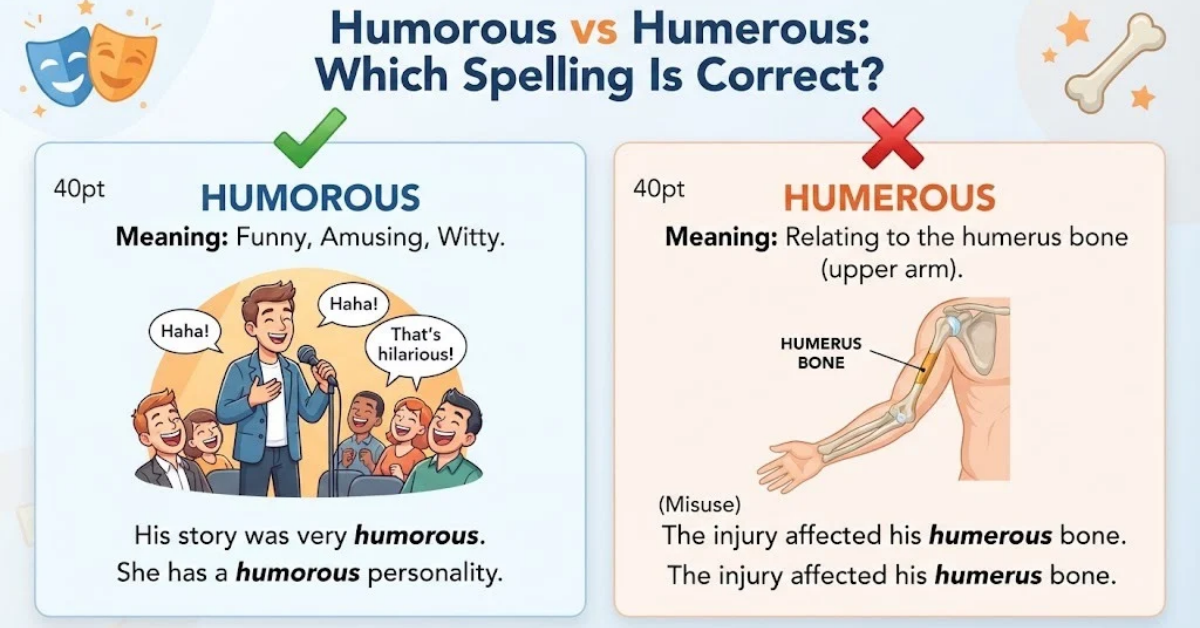
The important distinction is simple: humorous is the correct spelling when you mean “funny” or “amusing,” while humerous is generally a misspelling of that word. However, there’s an important reason this mistake happens: humerus is also a real English word—the name of the upper-arm bone.
In this guide, we’ll break down the difference between humorous and humerous, explain the correct spelling and meaning, look at pronunciation and examples, and show you an easy way to remember which word to use.
Humorous vs Humerous: The Quick Answer
If you are describing someone or something as funny, the correct word is humorous.
| Word | Correct? | Meaning |
| Humorous | Yes | Funny, amusing, or entertaining |
| Humerous | No | Usually a misspelling of “humorous” |
| Humerus | Yes | The long bone of the upper arm |
So, you might say:
The comedian gave a humorous speech.
But you would not normally write:
The comedian gave a humerous speech.
That second version is a spelling error.
What Does Humorous Mean?
Humorous is an adjective meaning funny, amusing, or likely to make people laugh.
It comes from the noun humor (or humour in British English). Something described as humorous contains or expresses humor.
Examples of “Humorous”
- She told a humorous story about her childhood.
- His humorous comments made everyone laugh.
- The article takes a humorous approach to everyday problems.
- My friend has a naturally humorous personality.
- The movie is lighthearted and humorous.
The word can describe people, writing, conversations, stories, speeches, situations, films, and many other things.
What Does Humerous Mean?
In standard English, humerous is not the correct spelling of the adjective meaning “funny.”
If you see humerous in a sentence such as:
“She has a very humerous personality.”
the writer almost certainly intended to write:
“She has a very humorous personality.”
The confusion is understandable because humerous looks like it could be a legitimate spelling. It resembles humerus, a genuine anatomical term, while also sounding similar to humorous.
For ordinary writing, however, remember this rule:
Funny = humorous.
Humorous vs Humerous vs Humerus
The three spellings can be especially confusing when you see them together. Here’s the easiest way to separate them.
1. Humorous
Humorous means funny or amusing.
Example:
The teacher told a humorous story to make the lesson more interesting.
2. Humerous
Humerous is generally considered a misspelling of humorous when the intended meaning is “funny.”
Incorrect:
He has a humerous personality.
Correct:
He has a humorous personality.
3. Humerus
Humerus is a completely different word. It refers to the long bone extending from the shoulder to the elbow.
Example:
The X-ray showed a fracture in the humerus.
Interestingly, humerus has an anatomical meaning, while humorous has a connection to humor and comedy.
Why Do People Confuse Humorous and Humerous?
The spelling confusion isn’t difficult to understand.
Both words are pronounced similarly, and when spoken aloud, the difference can be difficult to notice. The spelling humerous also looks plausible because English contains many words with similar patterns.
There is another source of confusion: humerus.
Someone familiar with the anatomical word may unconsciously write humerous when trying to spell humorous. The three words are close enough in appearance and sound to cause mistakes, particularly in informal writing.
This is one of those cases where knowing the meaning isn’t enough—you also need to remember the spelling.
Humorous Meaning and Usage
The adjective humorous can describe several kinds of humor.
For example, something can be:
- Witty – clever and amusing
- Comical – funny in an obvious or entertaining way
- Amusing – entertaining or enjoyable
- Playful – lighthearted and joking
- Funny – causing laughter or amusement
- Entertaining – enjoyable to watch, read, or hear
However, these words aren’t always perfect synonyms. Someone can be entertaining without being humorous, for example.
Humorous in a Sentence
Here are several natural examples:
- The author has a humorous writing style.
- His humorous response eased the tension in the room.
- She shared a humorous story at dinner.
- The advertisement uses humorous characters to attract attention.
- Despite the serious subject, the documentary has several humorous moments.
These examples all use humorous to describe something containing or expressing humor.
How Do You Spell Humorous?
The correct spelling is:
H-U-M-O-R-O-U-S
Humorous vs Humourous
If you’re using American English, humorous is the standard spelling.
In British English, the noun is commonly spelled humour, but the adjective is still generally spelled:
humorous
So:
- American English: humor → humorous
- British English: humour → humorous
A common mistake is writing humourous because of the British spelling humour. Although it may look logical, humorous is the standard spelling.
How Do You Pronounce Humorous?
Humorous is commonly pronounced approximately like:
HYOO-muh-rus or HYOO-mer-us
The exact pronunciation can vary somewhat by accent and speaking style.
The important point is that humorous, humerous, and humerus can sound very similar in everyday speech. That’s why the spelling distinction matters when you’re writing.
Is “Humerous” a Word?
If you’re asking whether humerous is the correct standard spelling for “funny,” the answer is no.
In most ordinary contexts, it is simply a misspelling of humorous.
Don’t confuse it with humerus, however. The latter is a legitimate anatomical term referring to the upper-arm bone.
So if you mean:
“This person is funny.”
Write:
This person is humorous.
If you mean:
“This bone is in the upper arm.”
Write:
This is the humerus.
Easy Trick to Remember the Correct Spelling
Here’s a simple memory trick:
Funny → Humor → Humorous
Think of the word humor first.
Humor + ous = humorous
The spelling contains “humor”:
humor + ous → humorous
You can also remember:
Humorous has “humor” inside it.
If you’re talking about comedy, jokes, laughter, or amusement, start with humor, and you’ll naturally arrive at humorous.
A Second Memory Trick
Keep the anatomical word separate:
Humerus = arm bone
Humorous = funny
If the sentence involves a joke, comedian, funny story, or amusing situation, humorous is the word you need.
Common Mistakes With Humorous
The most frequent spelling errors include:
“Humerous”
He made a humerous comment.
He made a humorous comment.
“Humourous”
The book has a humourous tone.
The book has a humorous tone.
Even though humour is the British spelling of the noun, the adjective is normally humorous.
“Humerus” When You Mean Funny
The movie was very humerus.
The movie was very humorous.
Humerus refers to a bone, so using it to describe a funny movie changes the meaning entirely—or simply creates an error.
Humorous vs Funny: Are They the Same?
Humorous and funny are closely related, but they aren’t always interchangeable in every context.
Funny is much more common in everyday conversation:
That movie was funny.
Humorous can sound slightly more descriptive or formal:
That movie was humorous.
The difference is mostly one of tone and usage. Funny is broad and conversational, while humorous often describes something that deliberately contains or expresses humor.
For example:
She wrote a humorous article about working from home.
This sounds natural and slightly more formal than:
She wrote a funny article about working from home.
Both can be correct depending on the context.
Synonyms for Humorous
If you’re looking for alternatives to humorous, consider:
- Funny
- Amusing
- Comical
- Witty
- Entertaining
- Hilarious
- Lighthearted
- Jovial
- Playful
- Whimsical
The best synonym depends on the type and intensity of humor.
For example, hilarious suggests something extremely funny, while witty emphasizes cleverness.
When Should You Use “Humorous”?
Use humorous when you want to describe something that contains, expresses, or creates humor.
Common contexts include:
Writing
The columnist has a humorous writing style.
Conversation
His humorous remarks kept the conversation lively.
Speeches
She delivered a humorous speech at the event.
Entertainment
The film combines serious drama with humorous moments.
Personality
He is known for his humorous personality.
In each case, humorous describes something connected with amusement or comedy.
Humorous vs Humerous: A Simple Comparison
| Feature | Humorous | Humerous |
| Standard spelling? | Yes | No, when meaning “funny” |
| Meaning | Funny or amusing | Usually a spelling error |
| Related word | Humor | Often confused with humerus |
| Example | A humorous story | Incorrect spelling |
| Common use | Writing and speech | Error |
And remember:
| Word | Meaning |
|---|---|
| Humorous | Funny or amusing |
| Humerous | Common misspelling |
| Humerus | Upper-arm bone |
Frequently Asked Questions
Is “humerous” the correct spelling?
No. If you mean “funny” or “amusing,” the correct spelling is humorous. Humerous is generally a misspelling.
Is it humorous or humerous?
It is humorous when you mean funny or amusing.
For example:
The comedian gave a humorous performance.
What is the difference between humorous and humerus?
Humorous means funny or amusing. Humerus is the long bone in the upper arm.
For example:
The humorous story made us laugh.
The doctor examined the humerus after the injury.
Is “humourous” correct?
No. The standard adjective is humorous, even though British English spells the noun as humour.
Correct:
humorous
Not:
humourous
How do you spell humorous?
The correct spelling is:
H-U-M-O-R-O-U-S
Does humorous mean funny?
Yes. Humorous means funny, amusing, or characterized by humor.
What is the noun form of humorous?
The related noun is humor in American English and humour in British English.
What is the opposite of humorous?
Depending on the context, possible opposites include serious, unfunny, somber, or humorless.
Final Verdict: Humorous vs Humerous
When choosing between humorous vs humerous, there’s a very simple answer: humorous is the correct spelling when you mean “funny” or “amusing.”
Humerous is generally a spelling mistake, while humerus is a legitimate anatomical term referring to the upper-arm bone.
The easiest way to remember the difference is:
Humorous = humor + ous = funny
Humerus = arm bone
So the next time you’re describing a funny story, clever joke, entertaining person, or amusing situation, go with humorous.
Once you connect the word with humor, the spelling becomes much easier to remember.