Have you ever typed “vender or vendor” and stopped to wonder which spelling is actually correct? You’re not alone. The two words look almost identical, and both can be found in English-language dictionaries, which makes the choice surprisingly confusing.
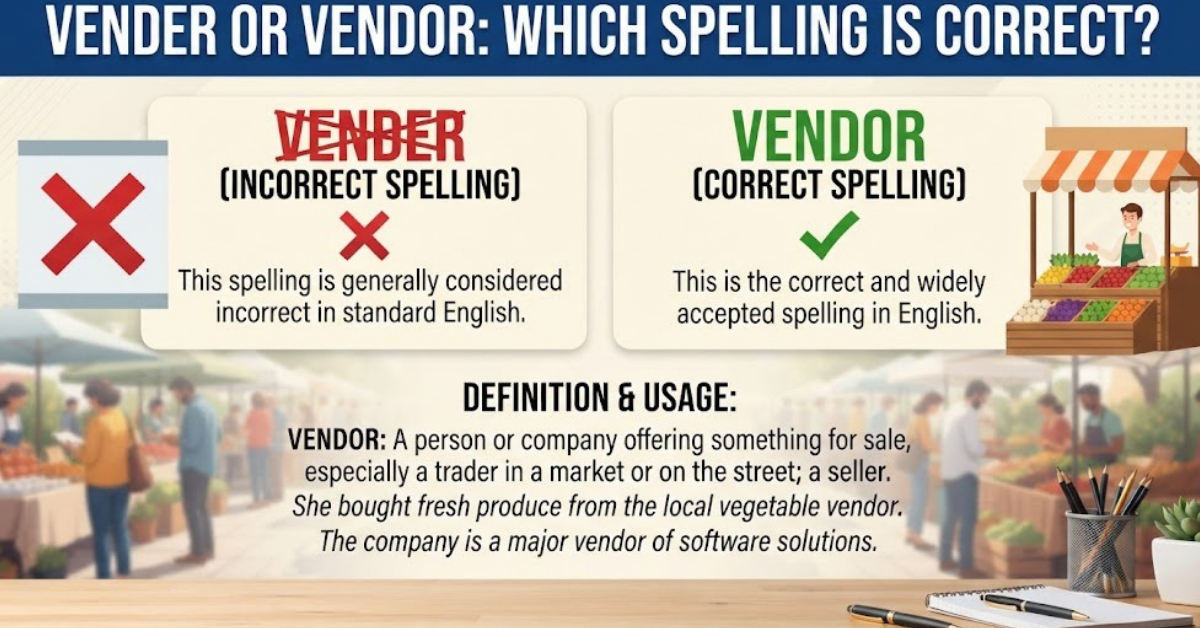
In modern English, vendor is overwhelmingly the standard spelling. It refers to a person or business that sells goods or services. Vender is also a legitimate spelling, but it is much less common and is generally treated as an alternative spelling of the same word.
If you’re writing an email, business document, website, report, résumé, or academic assignment, vendor is almost always the better choice.
Vender or Vendor: What Is the Correct Spelling?
Both vender and vendor can mean a person or company that sells something. However, vendor is the conventional and far more widely used spelling in contemporary English.
Vendor
Vendor is the standard spelling used in most modern writing.
A vendor can be:
- A person selling products at a market
- A company supplying goods to another business
- A software provider
- A service provider
- An online seller
- A supplier or merchant
For example:
We selected a new vendor to supply office equipment.
Or:
The company is negotiating a contract with an international software vendor.
Vender
Vender has the same basic meaning: someone who sells something.
However, this spelling is considerably less common. You may encounter it in dictionaries, older texts, or writing influenced by particular spelling preferences.
For most readers, vendor will look more natural and familiar.
Why Is “Vendor” More Common Than “Vender”?
The difference largely comes down to usage and historical spelling conventions.
Vendor entered English through Anglo-French and ultimately derives from Latin vendere, meaning “to sell.” English has historically used both vendor and vender, but “vendor” became the dominant spelling.
This is similar to other English words where spelling variations exist but one form becomes much more established through common usage.
Today, vendor is firmly entrenched in business, commerce, technology, retail, and everyday English.
You’ll commonly see phrases such as:
- Vendor management
- Vendor contract
- Vendor relationship
- Vendor selection
- Vendor payment
- Software vendor
- Food vendor
- Street vendor
- Third-party vendor
- Approved vendor
The spelling vender is possible, but it is rarely the preferred choice in professional writing.
Vendor Meaning Explained
The word vendor generally means a person or organization that sells goods or services.
The exact meaning can vary slightly depending on the context.
Vendor in Business
In business, a vendor is usually a company or individual that supplies products or services to another organization.
For example:
Our company hired a vendor to provide cybersecurity services.
Here, the vendor isn’t necessarily selling directly to consumers. It may be providing specialized services to another business.
Vendor in Retail
In retail, a vendor can be someone who sells products directly to customers.
For example:
A local fruit vendor set up a stall outside the market.
In this context, vendor is similar to seller, merchant, or trader.
Vendor in Technology
The technology industry uses the word vendor extensively.
A technology vendor might sell:
- Software
- Hardware
- Cloud services
- Cybersecurity solutions
- IT support
- Networking equipment
- Enterprise platforms
For example:
Microsoft is a major software vendor.
Here, “vendor” describes a company that provides technology products or services.
Vendor vs. Seller: What’s the Difference?
Although vendor and seller are closely related, they aren’t always interchangeable in practice.
Seller is a broad, everyday term for someone who sells something.
Vendor often has a more commercial or business-oriented meaning.
Consider these examples:
She is selling her old laptop.
“Seller” would be perfectly natural here.
The company is reviewing its software vendors.
“Vendor” is much more appropriate in this business context.
A vendor can therefore be thought of as a type of seller, although the terms don’t always carry exactly the same tone.
Vendor vs. Supplier: Are They the Same?
Vendor and supplier are also closely related, but there can be a subtle distinction.
A supplier typically provides goods, materials, or resources to another business, often as part of a supply chain.
A vendor can have a broader meaning and may sell either products or services.
For example:
The manufacturer purchases raw materials from several suppliers.
But:
The company uses several vendors for its software and consulting needs.
In everyday business communication, the terms may overlap, and many companies use them interchangeably.
Examples of “Vendor” in a Sentence
Seeing the word in context makes its meaning easier to understand.
- The store changed its primary clothing vendor.
- We need to contact the vendor about the delayed shipment.
- The food vendor sells fresh sandwiches near the station.
- Our IT department works with several software vendors.
- The company signed a long-term contract with a new vendor.
- All vendors must comply with the company’s security requirements.
- The event organizers hired a local vendor to provide catering services.
In each example, vendor refers to a person or organization providing something for sale.
Examples of “Vender” in a Sentence
Although vender is much less common, it can be used with the same basic meaning.
For example:
The street vender sold handmade crafts to tourists.
However, most modern readers would expect:
The street vendor sold handmade crafts to tourists.
That’s why vendor is generally the safer spelling.
Is “Vender” Wrong?
Not necessarily.
Vender is a recognized spelling, and it can mean the same thing as vendor. Calling it completely incorrect would therefore be misleading.
The important distinction is frequency and convention.
If you’re choosing between the two spellings for general or professional writing, vendor is the standard choice.
Think of it this way:
- Vendor: Correct, standard, common
- Vender: Correct, but uncommon and less preferred
- Best choice in most situations: Vendor
When Should You Use “Vendor”?
Choose vendor when writing for a general audience or in professional settings.
It is especially appropriate in:
- Business documents
- Contracts
- Emails
- Reports
- Marketing materials
- Websites
- Technical documentation
- Academic writing
- News articles
- E-commerce content
- Procurement documents
For example, if you’re preparing a business report, writing “vendor selection process” will generally sound more natural than “vender selection process.”
Common Vendor-Related Terms
Once you know the correct spelling, you’ll notice vendor in many business and commercial expressions.
Vendor Management
Vendor management is the process of overseeing relationships with companies that provide goods or services.
It can include:
- Selecting vendors
- Negotiating contracts
- Monitoring performance
- Managing payments
- Assessing risks
- Reviewing compliance
Vendor Agreement
A vendor agreement is a contract that establishes the terms between a buyer and a vendor.
It may cover pricing, delivery, responsibilities, confidentiality, payment terms, warranties, and termination conditions.
Vendor Relationship
A vendor relationship refers to the ongoing business relationship between an organization and its suppliers or service providers.
Strong vendor relationships can help businesses improve reliability, control costs, and maintain consistent quality.
Approved Vendor
An approved vendor is a supplier or service provider that has met an organization’s requirements and is authorized to do business with it.
Companies may evaluate vendors based on price, quality, reliability, security, certifications, and other criteria.
Why “Vender or Vendor” Is a Common Spelling Question
The confusion is understandable because English spelling doesn’t always follow a predictable pattern.
Many words use -er for someone who performs an action:
- Teach → teacher
- Drive → driver
- Sell → seller
- Manage → manager
Since the verb is vend, some people naturally assume that the person who vends should be spelled vender.
And historically, that spelling does exist.
However, vendor became the dominant form in standard modern English. As a result, people who encounter the word mainly in business, retail, or technology are much more likely to see “vendor.”
This is a good example of why English spelling cannot always be determined simply by applying a grammatical pattern.
Vender or Vendor in American English
In American English, vendor is overwhelmingly the more common spelling.
You will regularly encounter it in:
- Retail
- Procurement
- Software
- Business administration
- E-commerce
- Financial services
- Supply chain management
“Vender” is understood, but it is comparatively uncommon.
Vender or Vendor in British English
British English also commonly uses vendor.
While regional vocabulary and spelling differences exist between British and American English, this particular distinction does not create a major divide. Vendor remains the conventional spelling in both varieties.
So whether you’re writing for readers in the United States, United Kingdom, Canada, Australia, Pakistan, or elsewhere, vendor is generally the safest choice.
Vendor, Vender, or Vend: Understanding the Word Family
These words are related but serve different grammatical purposes.
Vend
Vend is a verb meaning to sell something.
The company vends software to small businesses.
Vendor
Vendor is a noun referring to the person or organization that sells something.
The software vendor released an update.
Vender
Vender is an alternative noun spelling for someone who sells something.
The market vender displayed handmade goods.
In modern usage, however, vendor is much more common.
A Simple Trick to Remember the Correct Spelling
If you frequently forget whether it is vender or vendor, use this simple rule:
For professional and everyday modern English, choose “vendor.”
You don’t need to worry about using “vender” unless you have a specific reason to follow that spelling.
When in doubt, remember common phrases such as:
vendor management, software vendor, vendor agreement, and street vendor.
These familiar expressions reinforce the standard spelling.
Vender or Vendor: Quick Comparison
| Feature | Vendor | Vender |
| Meaning | A person or organization that sells | A person who sells |
| Spelling | Standard | Alternative |
| Common today? | Yes | Much less common |
| Business writing | Recommended | Usually avoided |
| Technical writing | Common | Rare |
| General writing | Preferred | Acceptable but uncommon |
Frequently Asked Questions About Vender or Vendor
Is vendor the correct spelling?
Yes. Vendor is the standard and most widely used spelling for a person or organization that sells goods or services.
Is vender a real word?
Yes. Vender is a legitimate alternative spelling of vendor, although it is much less common in modern English.
Is vendor or vender more common?
Vendor is substantially more common. It is the preferred spelling in most contemporary business, technical, commercial, and general writing.
What does vendor mean?
A vendor is a person or organization that sells or supplies goods or services. The term is especially common in business, retail, technology, and procurement.
Is a vendor the same as a seller?
They can have similar meanings, but seller is more general and conversational, while vendor often has a commercial or business-related context.
Is a vendor the same as a supplier?
Not always. A supplier generally provides goods or materials, while vendor can refer more broadly to a business or individual selling goods or services. In everyday business language, the terms can overlap.
What is a software vendor?
A software vendor is a company or organization that develops, sells, licenses, or provides software products or services.
Should I use vendor in formal writing?
Yes. Vendor is the recommended choice for formal and professional writing, including business reports, contracts, websites, academic work, and technical documentation.
Final Verdict: Vender or Vendor?
So, vender or vendor—which should you use?
The answer is straightforward: use “vendor” in almost every modern writing situation.
Although vender is a valid alternative spelling, it is relatively uncommon and may look unusual to many readers. Vendor is the established form used across business, retail, technology, procurement, and everyday English.
If you’re writing an email, report, article, contract, website, or business document, choosing vendor will give your writing the familiar and professional spelling readers expect.