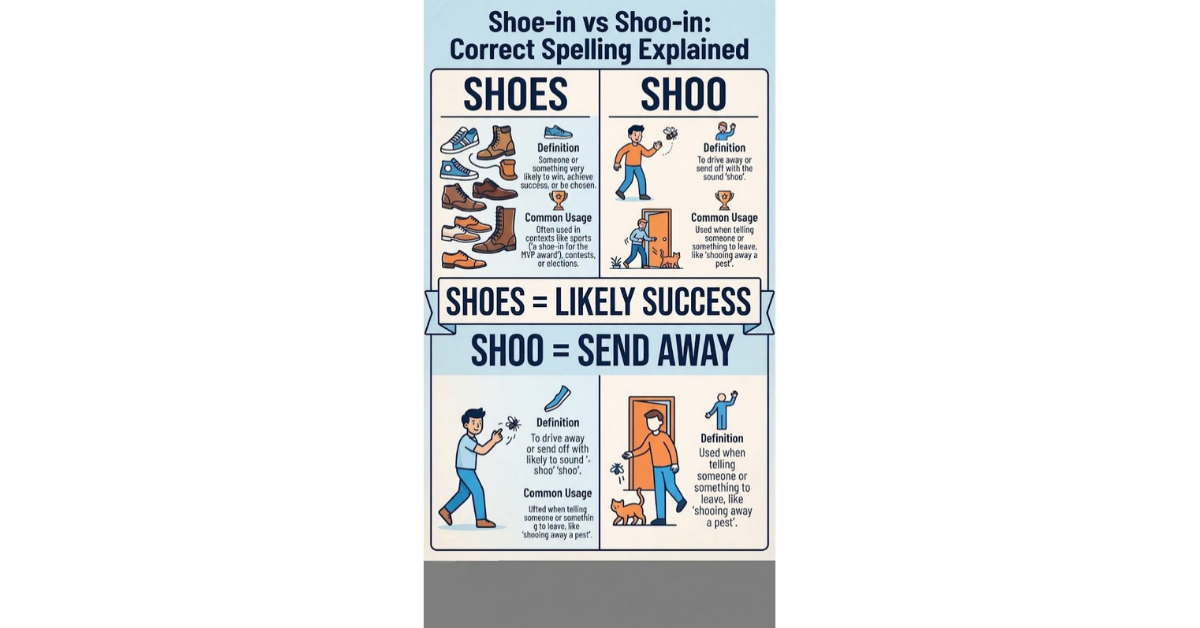
Have you ever written shoe-in or shoo-in and wondered which spelling is correct? You’re not alone. This expression is frequently misspelled because both versions sound similar, and the word’s meaning doesn’t seem to have anything to do with shoes.
When comparing shoe-in vs shoo-in, the correct spelling is shoe-in. It describes someone who is almost certain to win, succeed, or be selected for something. The incorrect spelling shoo-in is a common mistake, even though the word shoo is a legitimate English word with a completely different meaning.
In this guide, we’ll explain the difference between shoe-in and shoo-in, explore the expression’s history, and provide examples to help you use it confidently in everyday writing.
Shoe-in vs Shoo-in: Which One Is Correct?
The correct spelling is shoe-in, with the word shoe followed by a hyphen and the word in.
A shoe-in is a person or candidate who is almost guaranteed to win, receive a position, or achieve a particular outcome. The expression is commonly used in conversations about elections, competitions, promotions, awards, and other situations where success seems highly likely.
Here’s a quick comparison:
| Spelling | Correct or Incorrect? | Meaning |
|---|---|---|
| Shoe-in | Correct | Someone almost certain to succeed or win |
| Shoo-in | Incorrect for this expression | A common misspelling of shoe-in |
| Shoo | Correct word | To make someone or something go away |
For example:
- Correct: “She’s a shoe-in for the promotion.”
- Incorrect: “She’s a shoo-in for the promotion.”
Although readers will usually understand the incorrect version, using shoe-in is important for accurate and professional writing.
What Does Shoe-in Mean?
The expression shoe-in refers to someone or something that is almost certain to succeed.
It suggests that the outcome is so predictable that the person seems practically guaranteed to receive the desired result. However, it doesn’t mean that success is officially confirmed.
For instance, if a student consistently earns the highest grades in a class, someone might say:
“She’s a shoe-in for the academic award.”
This means the student is considered highly likely to win the award because of her strong performance.
Shoe-in Meaning in Everyday English
The expression can be used in several situations:
- Elections: A candidate who is expected to win comfortably.
- Employment: Someone who is highly likely to receive a job or promotion.
- Sports: A team or athlete expected to win a competition.
- Awards: A person considered almost certain to receive a prize.
- Competitions: A participant who appears to have a clear advantage.
The key idea is that the result seems nearly certain, although unexpected events can still change the outcome.
Why Is It Shoe-in Instead of Shoo-in?
The spelling shoe-in is often confusing because the expression sounds like shoo-in. However, its spelling is connected to the word shoe, not shoo.
The expression is believed to come from the idea of making something happen easily, as if it could be pushed or slipped into place without much difficulty.
The exact historical development of the phrase is not completely settled, but the standard spelling has long been shoe-in.
The Difference Between Shoe and Shoo
Understanding the two words makes the spelling distinction easier to remember.
Shoe is a noun referring to footwear. It can also appear in expressions and compound words, including shoe-in.
Shoo is a verb or interjection used to make someone or something move away.
For example:
- “I bought a new pair of shoes.”
- “She tried to shoo the birds away from the garden.”
The word shoo is often associated with the sound people make when trying to chase away birds or animals.
However, the expression describing a likely winner uses shoe, not shoo.
Examples of Shoe-in in Sentences
The best way to remember the correct spelling is to see it in context.
Here are some natural examples of how to use shoe-in in everyday English.
Shoe-in Examples in Professional Situations
- “With ten years of experience, he looks like a shoe-in for the senior manager position.”
- “She is a shoe-in for the promotion because of her excellent performance.”
- “The experienced applicant was considered a shoe-in for the job.”
Shoe-in Examples in Sports and Competitions
- “After winning every match this season, the team seems like a shoe-in for the championship.”
- “The defending champion is a shoe-in for another gold medal.”
- “Everyone expected the talented athlete to be a shoe-in for the final.”
Shoe-in Examples in Everyday Conversations
- “With her cooking skills, she’s a shoe-in for the family baking contest.”
- “That restaurant is a shoe-in for the best new dining spot.”
- “He’s a shoe-in to win the trivia competition.”
Notice that the expression is generally used when someone has a strong advantage or is widely expected to succeed.
Is Shoe-in Hyphenated?
Yes. The standard spelling is shoe-in, with a hyphen.
The hyphen is part of the conventional written form of the expression. Writing shoe in without the hyphen can make the meaning less clear, while shoo-in uses the wrong word.
Correct:
- “He’s a shoe-in for the award.”
- “She is considered a shoe-in for the position.”
Incorrect:
- “He’s a shoe in for the award.”
- “She is considered a shoo-in for the position.”
When writing the expression, keep the hyphen between shoe and in.
Is Shoe-in the Same as a Sure Thing?
The expressions shoe-in and sure thing have similar meanings, but they aren’t always interchangeable.
A shoe-in usually refers to a person or candidate who is expected to win, succeed, or be selected.
A sure thing can refer to a person, event, decision, or outcome that is considered certain.
For example:
- “She’s a shoe-in for the leadership position.”
- “The investment isn’t a sure thing.”
Both expressions communicate confidence in an outcome, but sure thing has a broader range of uses.
Other Synonyms for Shoe-in
Depending on the context, you can use these alternatives:
| Synonym | Meaning |
|---|---|
| Favorite | The person most likely to win |
| Frontrunner | The leading candidate in a competition |
| Strong contender | Someone with a good chance of success |
| Sure winner | Someone expected to win |
| Likely choice | Someone expected to be selected |
| Favorite to win | The person considered most likely to succeed |
These alternatives can help you avoid repeating shoe-in too often in an article or conversation.
Common Mistakes When Using Shoe-in
Even experienced writers sometimes confuse shoe-in with shoo-in. Here are a few mistakes to watch for.
1. Using Shoo-in Instead of Shoe-in
The most common mistake is replacing shoe with shoo. Remember that the standard expression always uses shoe-in.
2. Forgetting the Hyphen
The conventional spelling includes a hyphen. Avoid writing shoe in when you mean someone who is almost certain to win.
3. Using Shoe-in for a Guaranteed Outcome
A shoe-in is someone who is highly likely to succeed, not necessarily someone whose success is officially guaranteed.
For example, a candidate may be considered a shoe-in for an election but still lose unexpectedly.
4. Confusing Shoe-in With Shoo Away
The verb shoo means to drive someone or something away. It should not be used in the expression describing a likely winner.
Frequently Asked Questions
1. Is it shoe-in or shoo-in?
The correct spelling is shoe-in. It refers to someone who is almost certain to win, succeed, or be selected. Shoo-in is a common misspelling.
2. What does shoe-in mean?
A shoe-in is a person or candidate who is highly likely to succeed or win something. For example, “She’s a shoe-in for the award” means she is expected to receive it.
3. Why is shoe-in spelled with a shoe?
The expression uses the word shoe, not shoo. Its exact historical origin is uncertain, but the standard spelling is established as shoe-in.
4. Is shoe-in one word or two words?
Shoe-in is a hyphenated expression. The correct spelling includes a hyphen between shoe and in.
5. Can shoo-in ever be correct?
Shoo-in is not the standard spelling of the expression meaning a likely winner. However, shoo is a valid English word when used to mean driving someone or something away.
6. What is another word for shoe-in?
Common alternatives include frontrunner, favorite, strong contender, and sure winner. The best choice depends on the context.
7. Can someone be a shoe-in and still lose?
Yes. A shoe-in is someone expected to succeed, but the outcome is not guaranteed. Unexpected circumstances can still lead to a different result.
8. What is the plural of shoe-in?
The plural is shoe-ins. For example: “Both candidates were considered shoe-ins for the final round.”
Conclusion
When deciding between shoe-in vs shoo-in, remember that shoe-in is the correct spelling. It describes someone who is almost certain to win, succeed, or receive a particular opportunity.
The expression uses shoe, not shoo, and it should always include a hyphen. Although shoo is a legitimate English word, it means to drive someone or something away and has a different meaning entirely.
The next time you write about a likely winner, a promising job candidate, or someone expected to receive an award, use shoe-in with confidence. Exploring other commonly confused English expressions can also help you improve your spelling, vocabulary, and everyday communication.