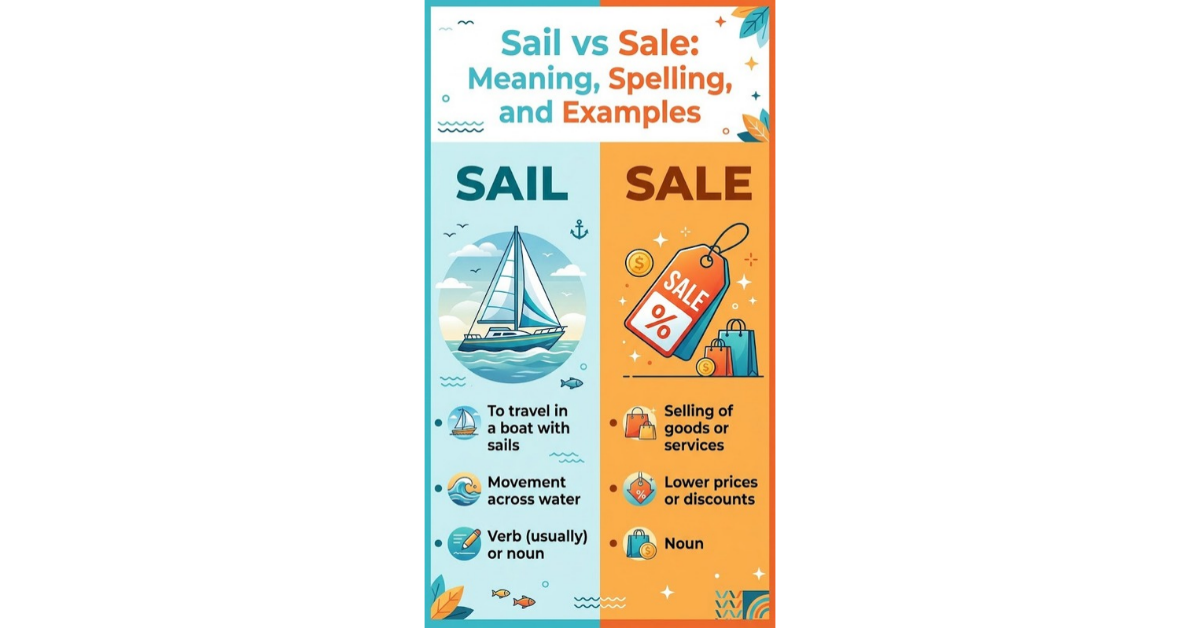
Have you ever written sail when you meant sale, or wondered which word belongs in a particular sentence? The difference between sail vs sale is easy to understand once you know what each word means. Although both words sound exactly alike, they have different spellings, meanings, and uses.
Sail usually relates to boats, ships, or traveling across water, while sale refers to selling something or offering products at reduced prices. Confusing them can change the meaning of a sentence, especially in business writing, emails, advertisements, and everyday conversations.
In this guide, you’ll learn the definitions of both words, see practical examples, explore common mistakes, and discover simple tricks to remember when to use sail or sale.
Sail vs Sale: Which Word Is Correct?
Both sail and sale are correct English words. The right choice depends entirely on what you want to say.
- Sail: A piece of fabric that catches the wind to move a boat, or the act of traveling on water in a boat or ship.
- Sale: The act of selling something, or an event where products are offered for purchase, often at discounted prices.
Here is a quick comparison:
| Feature | Sail | Sale |
|---|---|---|
| Meaning | A boat’s sail or traveling by boat | Selling something or a sales event |
| Part of speech | Noun and verb | Noun |
| Pronunciation | /seɪl/ | /seɪl/ |
| Example | “We will sail across the lake.” | “The store is having a sale.” |
| Common context | Boats, ships, sailing trips | Shopping, business, discounts |
The key difference is the context. If you’re talking about boats or traveling on water, sail is usually the correct word. If you’re discussing shopping, prices, or selling something, use sale.
What Does Sail Mean?
The word sail has several related meanings, most of which connect to boats, ships, or movement across water.
Sail as a Noun
As a noun, a sail is a piece of fabric or another suitable material attached to a boat or ship. It catches the wind and uses its force to help propel the vessel.
For example:
- “The boat’s sail was bright white.”
- “A strong wind filled the sail.”
- “The sailor repaired a damaged sail before leaving the harbor.”
Sails have been used for transportation and trade for centuries. Although modern boats may rely on engines, sailing vessels still use wind power to move across the water.
Sail as a Verb
As a verb, sail means to travel or move across water using a boat or ship. It can also describe operating a sailing vessel.
Examples include:
- “We plan to sail around the island this summer.”
- “The ship sailed out of the harbor at sunrise.”
- “They learned to sail when they were teenagers.”
- “The ferry sails between the two coastal towns every day.”
The word can also be used figuratively. For instance, saying that someone “sailed through an exam” means they completed it easily, without major difficulty.
What Does Sale Mean?
The word sale refers to the exchange of goods or services for money. It is commonly used in retail, business, marketing, and everyday shopping.
Sale as a Business Term
In business, a sale occurs when a product or service is sold to a customer. The word can describe a single transaction or the broader process of selling goods.
Examples:
- “The company recorded a successful sale.”
- “The car is for sale at a local dealership.”
- “The business increased its sales during the holiday season.”
Notice that sale and sales are related but not interchangeable in every sentence. Sale is singular, while sales is the plural form and is also widely used to describe the business activity of selling.
Sale as a Discount or Special Offer
In everyday shopping, a sale often refers to a promotion in which products are offered at reduced prices.
Examples:
- “The clothing store is having a summer sale.”
- “I bought these shoes during a weekend sale.”
- “The electronics sale ends on Friday.”
- “Several kitchen appliances are on sale this week.”
The phrase on sale commonly means that something is available at a discounted price, although in some contexts it can simply mean that tickets, products, or other items are available for purchase.
Sail vs Sale: Examples in Sentences
The easiest way to understand the difference between these homophones is to compare them in similar sentences.
| Sentence With Sail | Sentence With Sale |
|---|---|
| “The sailors raised the sail.” | “The store announced a sale.” |
| “We will sail tomorrow morning.” | “The car is for sale.” |
| “The ship sailed across the ocean.” | “The shop’s winter sale begins today.” |
| “She wants to learn how to sail.” | “She found a great deal during the sale.” |
| “The boat’s sail caught the wind.” | “The business completed another sale.” |
Each word makes sense in a different situation, even though both sound identical when spoken.
More Examples of Sail
Here are additional examples showing how sail appears in everyday English:
- “The captain decided to sail before the weather changed.”
- “A small sailboat moved slowly across the bay.”
- “We watched the ship sail into the distance.”
- “After months of practice, he can sail confidently.”
- “The project sailed through the approval process.”
The final example uses sail figuratively to describe something that progressed easily.
More Examples of Sale
These examples illustrate common uses of sale in shopping and business:
- “The furniture store is holding a clearance sale.”
- “I purchased the jacket on sale.”
- “The house is currently for sale.”
- “The online sale attracted thousands of customers.”
- “The final sale price was lower than expected.”
These sentences all relate to selling, purchasing, availability, or pricing.
How to Remember the Difference Between Sail and Sale
If you frequently mix up these words, a simple memory trick can help you choose the correct spelling.
1. Remember the Boat Connection
Think of the word sail as part of the word sailing. Both contain the letters s-a-i-l.
Whenever your sentence involves a boat, ship, wind, ocean, or sailing trip, sail is likely the right choice.
Example: “We will sail across the lake.”
2. Connect Sale With Shopping
The word sale contains the same spelling as the beginning of salesperson if you think of the shared letters sale and sales.
When your sentence involves prices, stores, discounts, selling products, or business transactions, choose sale.
Example: “The store is offering a discount during its annual sale.”
3. Replace the Word With a Synonym
Another useful technique is to substitute a related word and see whether the sentence still makes sense.
- If you can replace the word with travel by boat, use sail.
- If you can replace it with discount event or selling, use sale, depending on the sentence.
For example, “The ship will ___ tomorrow” clearly needs sail, because “the ship will travel by boat tomorrow” makes sense.
Likewise, “The store is having a ___” needs sale, because “the store is having a discount event” fits the intended meaning.
Common Phrases With Sail and Sale
Certain expressions make the difference especially easy to recognize.
Common Expressions With Sail
- Set sail: To begin a journey by boat or ship.
- Sail away: To leave or travel away by boat.
- Sail through: To complete something easily.
- Smooth sailing: A situation in which things proceed without major problems.
- Sailing boat: A boat designed to travel using sails.
Example: “After resolving the technical issues, the project was smooth sailing.”
Common Expressions With Sale
- For sale: Available for someone to buy.
- On sale: Available at a reduced price, or sometimes available for purchase.
- Clearance sale: An event where a retailer sells stock, often at reduced prices.
- Sale price: The price at which an item is sold, often a discounted price.
- Final sale: A sale or purchase subject to specific conditions, often meaning the item cannot be returned or exchanged.
Example: “The laptop is on sale for $500 this weekend.”
Understanding these expressions will help you recognize the correct word without having to stop and think about the spelling every time.
Sail vs Sale: Are They Homophones?
Yes, sail and sale are homophones. Homophones are words that sound alike but have different meanings and spellings.
Other familiar examples include:
- Sea vs see: A large body of salt water versus the act of looking.
- Buy vs by: To purchase something versus a preposition with several uses.
- Pair vs pear: Two matching or associated things versus a type of fruit.
- Flour vs flower: An ingredient used in baking versus the part of a plant that often produces seeds.
Homophones can cause spelling mistakes because pronunciation alone does not tell you which word to write. The best way to distinguish them is to understand their meanings and consider the context of the sentence.
Common Mistakes to Avoid When Using Sail or Sale
Even experienced writers occasionally confuse homophones, particularly when typing quickly. Here are a few mistakes worth watching for.
Incorrect: “The store is having a sail this weekend.”
Correct: “The store is having a sale this weekend.”
The sentence refers to a shopping promotion, so sale is correct.
Incorrect: “We plan to sale around the island.”
Correct: “We plan to sail around the island.”
The sentence describes traveling on water, so sail is the appropriate verb.
Incorrect: “This house is for sail.”
Correct: “This house is for sale.”
The phrase for sale means that a property is available to buy.
To avoid these errors, read your sentence once for meaning and again for spelling. Spell-checking tools can catch some mistakes, but they may not flag an incorrect homophone if the word is spelled correctly in isolation.
Frequently Asked Questions About Sail vs Sale
1. Is it sail or sale?
Both spellings are correct, but they have different meanings. Sail relates to boats or traveling on water, while sale relates to selling something or a shopping promotion.
2. What is the difference between sail and sale?
Sail is a noun or verb associated with sailing vessels and traveling across water. Sale is a noun that refers to selling goods or services, or to an event where products may be offered at discounted prices.
3. Is a house for sail or for sale?
The correct phrase is for sale. It means that the property is available for purchase. The word sail would be incorrect in this context.
4. Is it on sail or on sale?
The correct expression is on sale. It often means that a product is available at a reduced price, although it can also mean that something is available for purchase, such as event tickets.
5. Do sail and sale sound the same?
Yes. Sail and sale are pronounced the same way, usually as /seɪl/. Because they are homophones, you need to rely on their meanings and the surrounding sentence to choose the correct spelling.
6. What is the past tense of sail?
The past tense of sail is sailed. For example: “The ship sailed out of the harbor early in the morning.”
7. What is the plural of sale?
The plural is sales. For example: “The company increased its sales during the holiday season.” The word sales is also commonly used in phrases such as sales team and sales department.
8. How can I remember sail vs sale?
Associate sail with boats, ships, and sailing trips. Associate sale with shopping, selling, and discounts. These simple connections make it easier to select the right word when writing.
Conclusion
The difference between sail vs sale comes down to meaning, not pronunciation. Both words sound alike, but sail refers to a boat’s sail or the act of traveling on water, while sale relates to selling, purchasing, and special shopping offers.
Remember the simple rule: boats sail, and stores hold sales. When you’re unsure, check the meaning of the sentence before choosing your spelling.
With a little practice, you’ll be able to use both words confidently in emails, schoolwork, professional writing, and everyday conversations. For more helpful spelling guides, explore other commonly confused English words and learn how to use them correctly.