Have you ever written a sentence and wondered whether you should use altar or alter? These two words sound exactly alike, but their meanings are completely different. Choosing the wrong one can change the meaning of your sentence, especially when you’re writing about religion, weddings, or making changes to something.
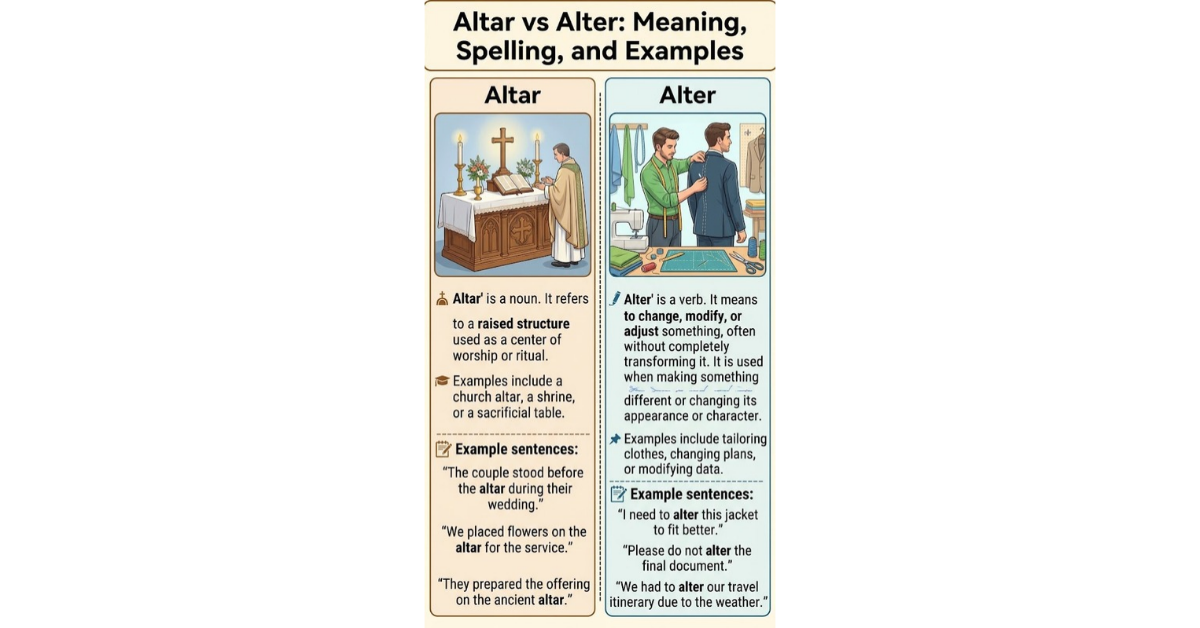
The difference between altar vs alter is simple once you understand how each word works. Altar is a noun that refers to a sacred table or structure used in religious ceremonies, while alter is a verb meaning to change or modify something.
In this guide, you’ll learn the definitions, pronunciation, spelling tricks, and real-life examples that will help you use both words with confidence.
Altar vs Alter: What Is the Difference?
The main difference between altar and alter is their meaning and grammatical function. Although they sound identical, they serve different purposes in a sentence.
| Word | Part of Speech | Meaning | Example |
| Altar | Noun | A sacred table or structure used in religious ceremonies | The couple stood before the altar. |
| Alter | Verb | To change, adjust, or modify something | I need to alter my schedule. |
Quick tip: An altar is a place or structure, while to alter something means to change it.
For example, a bride and groom may stand before an altar during a wedding ceremony. If they decide to change the wedding schedule, they need to alter their plans.
Remembering this distinction will help you avoid one of the most common homophone spelling mistakes in English.
What Does Altar Mean?
An altar is a raised table, platform, or other structure used for religious worship, prayer, offerings, sacrifices, or ceremonies. Altars appear in various religious traditions, although their design and purpose differ depending on the faith and cultural setting.
The word is most commonly associated with churches and religious ceremonies, but it can also refer to sacred spaces in other traditions.
Examples of Altar in a Sentence
Here are some examples that demonstrate the correct use of altar:
- The priest stood beside the altar during the service.
- The bride walked toward the altar with her father.
- Fresh flowers decorated the altar in the church.
- The family placed candles on a small home altar.
- Worshippers gathered around the altar for a religious ceremony.
In each sentence, altar refers to a physical structure or designated sacred space rather than an action.
What Does Altar Mean in a Wedding?
In a wedding context, the altar is the sacred or ceremonial area where a couple may exchange vows or participate in a marriage ceremony.
The expression “leave someone at the altar” is also used figuratively. It means abandoning someone at the point when a wedding is expected to take place, often by canceling the marriage at the last moment.
For example:
“She was afraid her fiancé would leave her at the altar.”
Here, the phrase refers to the wedding ceremony and the possibility of being abandoned before the marriage takes place.
Not every wedding uses a literal altar. The expression is often used more broadly for the place where a marriage ceremony occurs.
What Is an Altar Used For?
Depending on the religious or cultural tradition, an altar may be used for:
- Prayer and worship.
- Religious offerings and rituals.
- Ceremonies such as weddings or blessings.
- Displaying sacred objects, candles, flowers, or religious symbols.
- Marking a dedicated space for spiritual practice.
The specific purpose and appearance of an altar depend on the tradition in which it is used.
What Does Alter Mean?
Alter is a verb that means to change, modify, adjust, or make something different without necessarily replacing it completely.
You can alter clothing, plans, a document, a schedule, or even your approach to a problem. The change may be small or significant, depending on the situation.
Examples of Alter in a Sentence
Here are some everyday examples:
- I need to alter my dress before the wedding.
- The company decided to alter its business strategy.
- We had to alter our travel plans because of the weather.
- The tailor will alter the trousers to make them fit better.
- You can alter the document before submitting it.
- The new evidence may alter our understanding of the situation.
In all these examples, alter describes an action that changes something.
How Is Alter Used in Everyday Life?
The word alter appears in several common situations.
Clothing and tailoring: A tailor may alter a jacket by shortening its sleeves or adjusting its fit.
Plans and schedules: You might alter your plans if an appointment is canceled or an unexpected event occurs.
Documents and designs: An editor may alter a sentence to improve clarity, while a designer may alter a layout to make it more attractive.
Opinions and decisions: New information can alter someone’s opinion or influence a decision.
These examples show that alter is a versatile verb that works in both casual conversation and formal writing.
Altar vs Alter: How to Remember the Correct Spelling
Because altar and alter are pronounced the same way, listening to a sentence won’t usually tell you which spelling to choose. Instead, focus on the meaning of the word and its role in the sentence.
Here are a few simple memory tricks.
1. Associate Altar With a Sacred Place
Think of the phrase “altar at a church.” Both refer to a religious setting, making it easier to remember that altar is the noun.
Example: “The flowers were placed on the altar.”
2. Associate Alter With a Change
Think of alter and adjust. Both words begin with the letter A and can describe changing something.
Example: “I need to alter the design.”
3. Check Whether the Word Describes a Thing or an Action
Ask yourself what the sentence is trying to communicate:
- If it refers to a sacred structure or ceremonial space, use altar.
- If it describes changing or modifying something, use alter.
For instance, in “They decorated the altar,” the word refers to a place. In “They altered the decorations,” it describes an action.
This quick test works in most everyday writing situations.
Altar vs Alter in Common Expressions
Certain expressions make the difference easier to recognize.
| Expression | Correct Word | Meaning |
| Walk down the aisle to the altar | Altar | Approach the ceremonial area at a wedding |
| Leave someone at the altar | Altar | Abandon someone at the expected time of marriage |
| Alter your plans | Alter | Change your intended activities |
| Alter a dress | Alter | Adjust the clothing for a different fit |
| Alter the results | Alter | Change the results or their presentation |
| Religious altar | Altar | A structure or place used for worship |
Learning these common phrases can help you remember the correct spelling without having to look up the words every time.
Are Altar and Alter Homophones?
Yes. Altar and alter are homophones, meaning they have the same pronunciation but different meanings and spellings.
Other common English homophones include:
- Their, there, and they’re: Possession, place, and a contraction of “they are.”
- To, too, and two: A preposition, meaning “also” or “excessively,” and the number 2.
- Right and write: Correctness or direction, and the act of putting words on a page.
- Peace and piece: A state of calm and a portion of something.
Homophones can make English spelling challenging because context, rather than sound alone, determines which word is correct.
Common Mistakes When Using Altar and Alter
Even experienced writers sometimes confuse these words. The following mistakes are easy to avoid once you know what each word means.
Mistake 1: Using Alter When Referring to a Religious Structure
Incorrect: “The priest stood beside the alter.”
Correct: “The priest stood beside the altar.”
The sentence refers to a sacred structure, so the noun altar is required.
Mistake 2: Using Altar When Describing a Change
Incorrect: “We need to altar the schedule.”
Correct: “We need to alter the schedule.”
The sentence describes changing a plan, so the verb alter is correct.
Mistake 3: Assuming the Words Are Interchangeable
Although the words sound identical, they cannot be substituted for each other without changing the meaning or making the sentence incorrect.
A useful habit is to read the sentence and ask whether you’re describing a sacred place or an action involving change.
Altar vs Alter: Practice Quiz
Test your understanding with these five sentences. Choose the correct word for each blank.
1. The couple exchanged vows at the wedding _____.
- A. Alter
- B. Altar
2. I need to _____ the sleeves of my new shirt.
- A. Altar
- B. Alter
3. The family decorated the _____ with flowers and candles.
- A. Altar
- B. Alter
4. Unexpected rain forced us to _____ our travel plans.
- A. Altar
- B. Alter
5. The religious ceremony took place near the _____.
- A. Alter
- B. Altar
Answers: 1. B — Altar; 2. B — Alter; 3. A — Altar; 4. B — Alter; 5. B — Altar.
If you answered all five correctly, you’ve mastered the basic distinction between these commonly confused words.
Frequently Asked Questions
1. Is it altar or alter?
Both are correctly spelled English words, but they have different meanings. Altar is a noun referring to a sacred structure or ceremonial space, while alter is a verb meaning to change or modify something.
2. What is the difference between altar and alter?
An altar is a place or structure used in religious worship or ceremonies. Alter means to make a change to something, such as a plan, piece of clothing, or document.
3. Is an altar only used in churches?
No. Altars are found in different religious and cultural traditions, including temples and dedicated spaces in private homes. Their purpose and design vary by tradition.
4. What does “leave someone at the altar” mean?
The expression means abandoning someone when a wedding is expected to take place, often by canceling the marriage at the last moment. It can also be used figuratively to describe abandoning someone at a crucial moment.
5. What is the past tense of alter?
The past tense is altered. For example: “The tailor altered the jacket to improve its fit.”
6. Are altar and alter pronounced the same way?
Yes. In standard English pronunciation, the words are homophones. They sound the same, so you must use the sentence’s meaning to determine the correct spelling.
7. Can alter be used as a noun?
In standard everyday English, alter is primarily used as a verb. The noun form for the action or result of changing something is usually alteration.
8. How can I remember altar vs alter?
Remember that an altar is associated with a church, temple, or ceremonial space, while alter means to adjust or change something. Thinking of “alter your plans” and “altar at a wedding” is a simple way to keep them separate.
Conclusion
Understanding altar vs alter becomes easy once you focus on what each word means. An altar is a sacred structure or ceremonial space, while alter means to change, adjust, or modify something.
Although these words sound identical, they serve different grammatical purposes and cannot be used interchangeably. Remember the connection between altar and religious ceremonies, and between alter and making changes, to avoid confusion in your writing.
The next time you encounter these words, check the meaning of your sentence before choosing the spelling. You can also explore other commonly confused English words to strengthen your vocabulary, improve your spelling, and communicate more confidently.