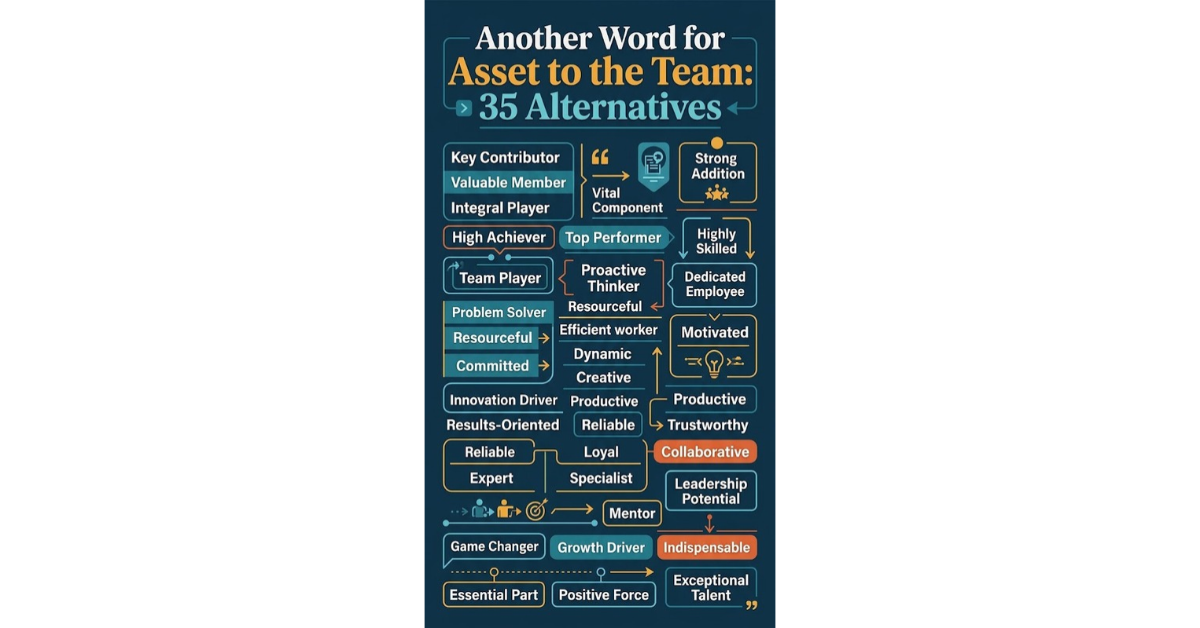
Finding the right words to describe someone who makes a meaningful contribution at work can make a real difference in how your message comes across. Whether you’re writing a performance review, updating a résumé, recommending a colleague, or recognizing an employee’s achievements, knowing another word for asset to the team helps you communicate appreciation more clearly and professionally.
The phrase “an asset to the team” describes someone whose skills, attitude, experience, or contributions make the group stronger. However, repeating the same expression can make your writing feel predictable. Alternatives such as valuable contributor, key team member, trusted colleague, and team player can convey a similar idea while emphasizing different strengths.
In this guide, you’ll discover useful synonyms, their meanings, practical examples, and tips for choosing the best expression for different workplace situations.
What Is Another Word for Asset to the Team?
Some of the best alternatives to “asset to the team” include:
- Valuable contributor
- Valuable team member
- Key contributor
- Team player
- Indispensable colleague
- Trusted team member
- Valuable resource
- Integral part of the team
- Key team member
- Reliable colleague
- Strong contributor
- Highly valued employee
- Essential team member
- Collaborative professional
- Outstanding performer
The best choice depends on what you want to emphasize. For example, valuable contributor highlights someone’s impact, while team player focuses on cooperation and collaboration.
35 Best Synonyms for Asset to the Team
Here are 35 alternatives you can use in professional writing, workplace conversations, performance evaluations, and employee recognition.
Professional and Formal Alternatives
These expressions work particularly well in business reports, recommendation letters, performance reviews, and formal emails.
- Valuable contributor — Someone who consistently makes meaningful contributions to team goals.
- Key team member — A person who plays an important role in the team’s success.
- Integral part of the team — Someone whose involvement is closely connected to the team’s overall effectiveness.
- Indispensable colleague — A colleague whose expertise or contribution is especially difficult to replace.
- Essential team member — Someone who fulfills an important function within the group.
- Highly valued employee — A professional whose work and qualities are appreciated by the organization.
- Key contributor — Someone whose work has a noticeable effect on results.
- Valuable resource — A person who provides useful knowledge, expertise, or support.
- Trusted professional — Someone who consistently demonstrates sound judgment and reliability.
- Strategic contributor — A person whose work supports important business priorities.
Alternatives That Highlight Teamwork
If the person is especially good at working with others, these expressions may be more appropriate.
- Team player — Someone who cooperates effectively with colleagues.
- Collaborative colleague — A person who shares ideas and works constructively with others.
- Supportive team member — Someone who helps colleagues overcome challenges and complete tasks.
- Reliable teammate — A person others can depend on to follow through on commitments.
- Cooperative professional — Someone who contributes to a positive working relationship.
- Trusted colleague — A person respected for their judgment, consistency, and integrity.
- Positive team influence — Someone whose attitude and behavior help create a constructive work environment.
- Team-oriented professional — A person who considers shared goals alongside individual responsibilities.
- Collaborative contributor — Someone who actively participates in shared projects and decisions.
- Dependable team member — A person who consistently meets expectations and supports team objectives.
Alternatives That Emphasize Skills and Performance
Use these phrases when you want to recognize someone’s expertise, productivity, or ability to solve problems.
- High-performing employee — Someone who regularly delivers strong results.
- Skilled contributor — A person whose abilities directly support the team’s work.
- Problem-solving expert — Someone who helps identify challenges and develop practical solutions.
- Subject-matter expert — A professional with specialized knowledge in a particular area.
- Driving force behind the team — Someone who helps move projects forward and maintain momentum.
- Results-driven professional — A person who focuses on achieving measurable outcomes.
- Innovative thinker — Someone who introduces useful ideas or new approaches.
- Productive team member — A person who completes meaningful work and helps the group meet its objectives.
- Performance contributor — Someone whose efforts support the team’s overall results.
- Resourceful colleague — A person who finds practical ways to address problems and work with available resources.
Alternatives That Highlight Leadership and Initiative
These expressions are useful when describing employees who take responsibility, motivate others, or help guide projects.
- Emerging leader — Someone who demonstrates growing leadership potential.
- Initiative-taker — A person who acts proactively instead of waiting for instructions.
- Motivating presence — Someone who encourages others and helps maintain enthusiasm.
- Trusted advisor — A colleague whose knowledge and judgment help others make informed decisions.
- Team catalyst — Someone who encourages progress, collaboration, or positive change.
Which Synonym for Asset to the Team Should You Use?
Not every alternative communicates exactly the same thing. Choosing the right phrase depends on the person’s contribution and the context in which you’re describing them.
| Situation | Best Alternative | Why It Works |
| Performance review | Valuable contributor | Emphasizes meaningful work |
| Résumé | Key contributor | Highlights professional impact |
| Employee recognition | Highly valued team member | Expresses appreciation |
| Recommendation letter | Trusted professional | Communicates credibility |
| Teamwork assessment | Collaborative colleague | Emphasizes cooperation |
| Leadership evaluation | Emerging leader | Highlights leadership potential |
| Project update | Essential team member | Recognizes an important role |
| Informal workplace message | Great team player | Sounds friendly and natural |
| Technical role | Subject-matter expert | Highlights specialized knowledge |
| Reliability assessment | Dependable colleague | Emphasizes consistency |
For the strongest result, choose a phrase that reflects the person’s actual strengths rather than simply selecting the most impressive-sounding synonym.
Another Word for Asset to the Team in a Performance Review
Performance reviews are an excellent opportunity to recognize the specific ways an employee contributes to a team’s success. Instead of relying on the general phrase “asset to the team,” use language that identifies the employee’s strengths and accomplishments.
Here are some examples you can adapt.
1. Valuable contributor
“Sarah is a valuable contributor who consistently delivers high-quality work and supports the team’s objectives.”
2. Reliable team member
“James is a reliable team member who meets deadlines, communicates clearly, and follows through on commitments.”
3. Collaborative professional
“Maria is a collaborative professional who shares knowledge freely and helps colleagues solve complex problems.”
4. Key contributor
“David has been a key contributor to several successful projects, demonstrating strong organizational skills and sound judgment.”
5. Positive influence
“Emily is a positive influence on the team, encouraging cooperation and helping maintain a constructive work environment.”
How to Make Performance Review Statements Stronger
A strong performance review describes not only someone’s qualities but also how those qualities affect the team’s work.
For example, instead of writing:
“Alex is a great asset to the team.”
You could write:
“Alex is a valuable contributor who streamlined the reporting process, helped colleagues resolve technical issues, and consistently delivered projects on schedule.”
The second version provides concrete evidence of the employee’s value. Whenever possible, support your praise with examples, measurable results, or observable behaviors.
Another Word for Asset to the Team on a Résumé
On a résumé, the phrase “asset to the team” is usually less effective than a description of the skills or achievements that make you valuable. Recruiters benefit more from specific evidence than from general statements of self-praise.
Consider these alternatives:
- Results-driven professional: Suitable for roles that emphasize measurable outcomes.
- Collaborative team member: Useful for positions involving cross-functional work.
- Proven contributor: Appropriate when you have a track record of delivering results.
- Skilled problem-solver: Ideal for roles that require analytical thinking.
- Process improvement specialist: Useful when you have improved workflows or efficiency.
- Experienced project contributor: Appropriate for project-based responsibilities.
Résumé Examples
Instead of writing, “I am an asset to the team,” try one of these statements:
- “Collaborated with a cross-functional team to deliver projects ahead of schedule.”
- “Contributed to process improvements that reduced administrative work.”
- “Supported team productivity by resolving customer issues and sharing technical knowledge.”
- “Coordinated project activities to improve communication and meet deadlines.”
These examples are stronger because they focus on actions and outcomes. If you have reliable figures, include them to make your achievements more specific.
Another Word for Asset to the Team in a Recommendation Letter
A recommendation letter should establish why a person deserves consideration for a job, promotion, scholarship, or other opportunity. Selecting the right expression can make the recommendation more precise and convincing.
Useful phrases include:
- A highly valued member of the team
- A dependable and skilled professional
- A trusted colleague with strong judgment
- An effective collaborator
- A consistent contributor to team success
- A professional with exceptional problem-solving skills
- A colleague who strengthens team performance
For example:
“I strongly recommend Daniel as a dependable and skilled professional. His ability to coordinate with colleagues, manage competing priorities, and resolve challenges made him a highly valued member of our team.”
This wording highlights practical qualities rather than relying on a broad compliment alone.
Another Word for Asset to the Team in an Email
Workplace emails often call for a warm, straightforward expression. You don’t necessarily need formal corporate language to recognize someone’s contribution.
Here are some natural examples:
- “You’re a valuable part of our team.”
- “Your contributions make a real difference.”
- “We’re fortunate to have you on the team.”
- “Your support has been instrumental in our progress.”
- “You’re a trusted colleague, and we appreciate your help.”
- “Your ideas have helped us move this project forward.”
For a formal email, “Your contributions have been valuable to the team’s success” is a professional option.
For a friendly message, “We’re lucky to have you on the team” sounds more personal and conversational.
Is “Asset to the Team” a Compliment?
Yes. Calling someone an “asset to the team” is a positive statement that recognizes their value to a group or organization.
It suggests that the person’s skills, effort, experience, attitude, or knowledge make a meaningful contribution. The expression can apply to employees, managers, colleagues, volunteers, and even members of a project group.
However, the phrase is somewhat general. If you want your compliment to feel more personal, identify the quality that makes the person valuable.
For example:
- “You’re a valuable team member because you always help others meet deadlines.”
- “Your technical expertise has been essential to this project’s success.”
- “Your calm approach helps the team work through difficult situations.”
Specific praise is often more memorable because it shows that you recognize what the individual actually does well.
How to Describe Someone Who Adds Value to a Team
If you’re struggling to find the right words, start by identifying the person’s strongest contribution. The best description should reflect their behavior, skills, and impact rather than simply sound impressive.
Use this simple process:
- Identify the strength. Does the person excel at communication, leadership, problem-solving, organization, or technical work?
- Consider the impact. Do they improve productivity, support colleagues, resolve problems, or help achieve business goals?
- Choose a suitable phrase. Match the wording to the person’s contribution.
- Add a real example. Explain what the person did and why it mattered.
For example, if a colleague regularly helps new employees learn company processes, you might describe them as a “supportive team member” or “trusted mentor.”
If another colleague consistently finds solutions to difficult technical problems, “resourceful problem-solver” may be a better fit.
The goal is to describe the person’s value accurately, not to use the most elaborate vocabulary.
Common Mistakes to Avoid When Choosing a Synonym
Although many phrases can replace “asset to the team,” some may not fit every situation.
Using overly strong language: Words such as “indispensable” imply that someone is exceptionally difficult to replace. Use them when the person’s contribution genuinely warrants that description.
Choosing vague praise: Expressions such as “great employee” are positive but don’t explain what the person does well.
Overusing corporate jargon: Terms such as “strategic contributor” may be appropriate in a formal report, but they can sound unnatural in a casual message.
Ignoring context: A résumé, performance review, recommendation letter, and thank-you email have different purposes. Choose language that fits the document.
Making unsupported claims: In professional writing, specific and accurate examples are more persuasive than exaggerated praise.
Frequently Asked Questions
1. What is the best word for an asset to the team?
“Valuable contributor” is one of the best general alternatives. It communicates that someone makes a meaningful contribution without implying that they are impossible to replace.
2. What is another way to say “you are an asset to the team”?
You could say, “You’re a valuable member of the team,” “Your contributions make a real difference,” or “We’re fortunate to have you on the team.” The best choice depends on how formal or personal you want the message to sound.
3. What is a professional synonym for asset?
Professional alternatives include valuable resource, key contributor, essential team member, trusted professional, and valued employee. The most suitable option depends on whether you’re describing skills, performance, teamwork, or overall contribution.
4. What does it mean to be an asset to a team?
It means that a person’s abilities, knowledge, behavior, or work makes the team more effective. This could involve meeting deadlines, sharing expertise, supporting colleagues, solving problems, or contributing to successful outcomes.
5. What is another word for a valuable team member?
You can use key team member, valued colleague, reliable teammate, important contributor, or integral team member. Each phrase highlights the person’s importance in a slightly different way.
6. How do you say someone is a great team player professionally?
You might write, “They demonstrate strong collaboration skills and consistently support shared goals.” Another option is, “They work effectively across teams and contribute to a positive, productive environment.”
7. How do you describe an employee who brings value to a company?
Focus on the employee’s contribution. For example, describe them as a results-driven professional, skilled problem-solver, innovative contributor, or experienced specialist. Whenever possible, include examples of achievements or improvements they have delivered.
8. Is “valuable contributor” better than “asset to the team”?
Neither phrase is universally better. “Valuable contributor” emphasizes the work someone performs, while “asset to the team” is a broader compliment about their overall value. In résumés and performance reviews, specific descriptions of achievements are usually more informative than either phrase alone.
Conclusion
Finding another word for asset to the team is about more than avoiding repetition. The right expression helps you recognize someone’s strengths, communicate appreciation, and describe their professional value with greater precision.
For general workplace writing, valuable contributor, key team member, and trusted colleague are excellent alternatives. For résumés and performance reviews, choose language that emphasizes skills, collaboration, leadership, or measurable achievements.
Before using any synonym, consider the context and the contribution you want to highlight. A specific, sincere description will usually communicate more than a generic compliment—and help your writing sound more professional, natural, and meaningful.