Have you ever tried to spell a word and found yourself moving the letters around until something looks right? Camouflage or camoflauge is a common spelling dilemma because both versions look believable at first glance. However, only one is the standard English spelling.
The correct spelling is camouflage. The word camoflauge is a misspelling, usually caused by mixing up the positions of the letters “l” and “u.”
Camouflage is used to describe methods of hiding or disguising people, animals, objects, and even patterns in clothing. Whether you’re writing about military uniforms, wildlife, fashion, or nature, knowing the correct spelling helps you communicate clearly.
In this guide, you’ll learn the difference between camouflage and camoflauge, understand the word’s meaning, explore practical examples, and discover simple tricks to remember the correct spelling.
Camouflage or Camoflauge: Which Is Correct?
When comparing camouflage vs. camoflauge, the answer is straightforward: camouflage is correct, while camoflauge is a spelling mistake.
Here’s a quick comparison:
| Spelling | Correct? | Explanation |
| Camouflage | Yes | The standard English spelling |
| Camoflauge | No | A common misspelling |
| Camo | Yes | An informal abbreviation of camouflage |
For example:
- Correct: The soldiers wore camouflage uniforms.
- Incorrect: The soldiers wore camoflauge uniforms.
- Informal: He bought a new camo jacket.
The word camo is widely used in everyday conversation, especially when discussing clothing, hunting gear, and military-inspired fashion.
What Does Camouflage Mean?
Camouflage refers to a method of concealing something by making it blend into its surroundings or become less noticeable.
It can involve colors, patterns, shapes, textures, or other techniques that make a person, animal, or object harder to see or recognize.
Camouflage is commonly associated with three main areas:
- Nature: Animals use camouflage to avoid predators or approach prey.
- Military: Soldiers and equipment use camouflage to reduce visibility in particular environments.
- Everyday life: Camouflage patterns appear on jackets, trousers, backpacks, accessories, and decorative products.
For example, a green insect resting on a leaf may be difficult to notice because its color resembles the plant around it.
Similarly, a person wearing clothing with woodland camouflage may be less visible against certain forest backgrounds. However, camouflage does not make someone invisible; its effectiveness depends on the surroundings, lighting, movement, and pattern.
Why Do People Spell Camouflage as Camoflauge?
The misspelling camoflauge is understandable because the word is not spelled exactly as many people expect it to sound.
Several factors can contribute to the mistake.
1. The Letters Are Easy to Mix Up
The correct word contains the sequence -flage, whereas the incorrect spelling rearranges the letters into -flauge.
When writing quickly, people may remember the general sound of the word but place the letters in the wrong order.
2. Pronunciation Doesn’t Reveal Every Letter
Camouflage is commonly pronounced approximately as KAM-uh-flahzh in English.
Because the final part sounds different from how some readers might expect it to be spelled, remembering the exact letter sequence can be difficult.
3. The Word Is Borrowed From French
The English word camouflage comes from French. Its unusual spelling and pronunciation may feel less intuitive to people who are unfamiliar with its origin.
The word entered English in the early 20th century and became particularly associated with military concealment during World War I.
Understanding its history can make the spelling easier to recognize, even though memorizing the correct letter sequence is the simplest solution.
How to Spell Camouflage Correctly
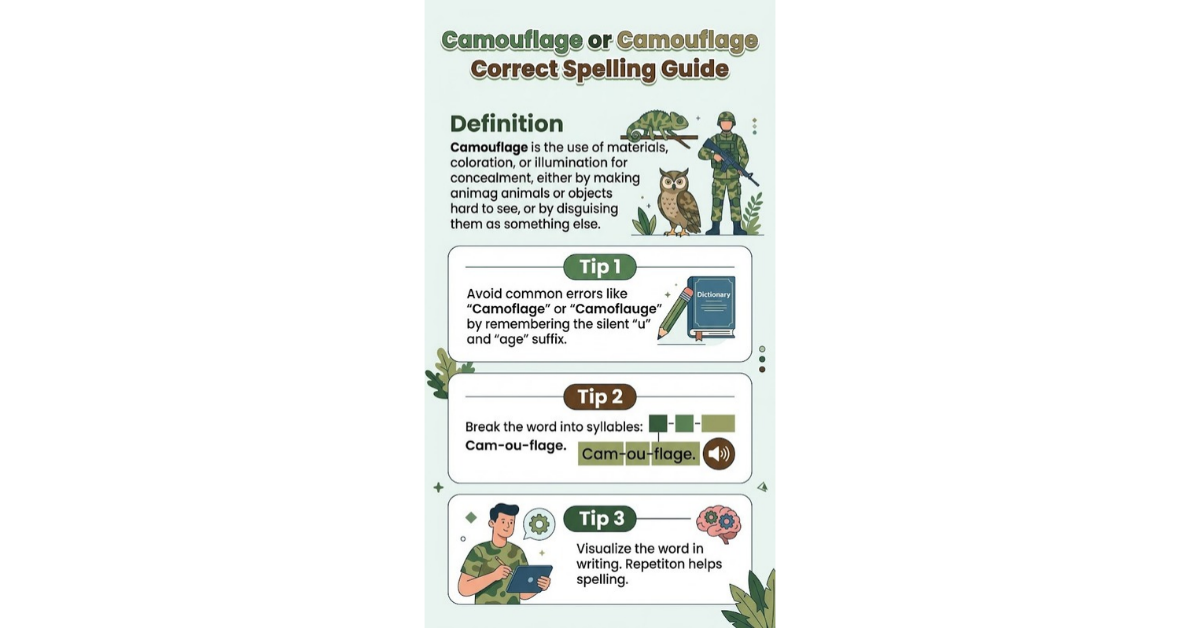
The easiest way to learn the correct spelling is to break the word into smaller parts.
C-A-M-O-U-F-L-A-G-E
The correct spelling is:
CAMOUFLAGE
Pay particular attention to the middle letters:
O-U-F-L-A-G-E
The incorrect version, camoflauge, rearranges the “u” and “l” in this sequence.
A Simple Memory Trick
Try remembering this phrase:
“Camouflage helps you blend into the surroundings.”
Whenever you write the word, picture a green leaf blending into a tree. Then recall the correct sequence: camou-flage.
Another helpful tip is to practice writing the word a few times:
- Camouflage
- Camouflage pattern
- Camouflage clothing
- Military camouflage
- Natural camouflage
Repeating the word in meaningful phrases can help you remember it more easily than memorizing isolated letters.
How to Use Camouflage in a Sentence
Camouflage can function as both a noun and a verb. It can also appear as an adjective-like modifier in phrases such as camouflage clothing.
Camouflage as a Noun
As a noun, camouflage refers to the method, pattern, or material used to conceal something.
Examples:
- The soldier wore camouflage during the exercise.
- The chameleon’s camouflage helped it blend into its surroundings.
- The hunters wore camouflage jackets in the forest.
- The vehicle was painted with a desert camouflage pattern.
- The bird’s natural camouflage made it difficult to spot.
Camouflage as a Verb
As a verb, camouflage means to hide or disguise something by making it less noticeable.
Examples:
- The artist used paint to camouflage the scratches on the wall.
- Some insects camouflage themselves by resembling leaves.
- The equipment was camouflaged to match the surrounding terrain.
- The company tried to camouflage the damage with a fresh coat of paint.
Camouflage in Everyday Conversation
The word can also be used figuratively to describe hiding feelings, intentions, or problems.
For example:
- He tried to camouflage his disappointment with a smile.
- Humor can sometimes camouflage nervousness.
- The decorative design camouflaged the small imperfections.
In these examples, camouflage refers to making something less obvious rather than physically blending into the environment.
What Is Camouflage Used For?
Camouflage has many applications beyond military clothing. Its basic purpose is to reduce visibility or make something harder to distinguish from its surroundings.
1. Military Camouflage
Military camouflage is designed to help personnel, vehicles, equipment, and structures blend into particular environments.
Different patterns may be designed for woodland, desert, snow, or urban settings. No single pattern is equally effective in every environment.
2. Animal Camouflage
Many animals have physical features that help them avoid detection.
Examples include:
- Stick insects that resemble branches.
- Snowshoe hares whose winter coats can blend into snowy surroundings.
- Leaf-tailed geckos that resemble tree bark or dead leaves.
- Octopuses that can change their skin color and texture to match aspects of their surroundings.
Animal camouflage can help with predator avoidance, hunting, and survival.
3. Hunting and Outdoor Activities
Camouflage clothing is popular among hunters, wildlife photographers, birdwatchers, and outdoor enthusiasts.
Its usefulness depends on the terrain, vegetation, season, and activity. In some hunting situations, visibility to other people is also important, so appropriate safety equipment and local regulations should never be overlooked.
4. Fashion and Design
Camouflage patterns have become a familiar feature of casual clothing and accessories.
You may see them on:
- Jackets and trousers
- Sneakers
- Backpacks
- Hats
- Watches and accessories
- Home decor
In fashion, camouflage is often chosen for its distinctive appearance rather than its ability to conceal the wearer.
Camouflage vs. Camo: What’s the Difference?
Camouflage is the full word, while camo is its informal shortened form.
Both are correct, but their use depends on the situation.
| Word | Typical use | Example |
| Camouflage | Formal writing and general descriptions | The animal uses camouflage. |
| Camo | Casual conversation and fashion | I bought a camo jacket. |
Use camouflage in academic assignments, professional articles, and formal documents. Use camo when a relaxed, conversational tone is appropriate.
Camouflage vs. Concealment: Are They the Same?
Camouflage and concealment are related, but they are not identical.
Camouflage generally involves disguising something or helping it blend into its surroundings.
Concealment is a broader term for keeping something hidden or preventing it from being seen.
For example, a green pattern that blends into woodland is camouflage. Placing an object behind a wall is concealment, even if the object does not resemble the wall.
Camouflage can therefore be one method of concealment, but not every form of concealment uses camouflage.
Synonyms for Camouflage
Depending on the context, several words can express an idea similar to camouflage.
| Synonym | Meaning |
| Disguise | Change the appearance of something to hide its identity |
| Conceal | Keep something from being seen or discovered |
| Mask | Hide or cover something |
| Obscure | Make something difficult to see or understand |
| Hide | Keep something out of sight |
| Cover | Place something over or around another thing |
| Veil | Partially hide or obscure something |
These words are related, but they are not always interchangeable.
For example, an animal may camouflage itself by blending into a tree, while a person may disguise their identity by changing their appearance.
Frequently Asked Questions About Camouflage or Camoflauge
Is it spelled camouflage or camoflauge?
The correct spelling is camouflage. Camoflauge is a common misspelling caused by mixing up the positions of the letters “l” and “u.”
Why is camouflage so difficult to spell?
Camouflage can be difficult to spell because its letter sequence is not immediately obvious from its pronunciation. Remembering the middle sequence O-U-F-L can help prevent mistakes.
How do you pronounce camouflage?
In English, camouflage is commonly pronounced approximately as KAM-uh-flahzh. Pronunciation varies slightly by accent, but the spelling remains the same.
What does camouflage mean in simple words?
Camouflage means hiding something by making it blend into its surroundings or become harder to notice. Animals, military personnel, and clothing designers all use camouflage in different ways.
Is camo a correct word?
Yes. Camo is a widely recognized informal abbreviation of camouflage. It is especially common when discussing clothing, accessories, and outdoor equipment.
What is the plural of camouflage?
Camouflage is usually an uncountable noun when referring to the general technique of concealment. However, camouflages can be used when referring to different forms or instances of camouflage.
For example: “The study examined several types of animal camouflages.”
What is the verb form of camouflage?
The word camouflage is also a verb. Its forms include camouflages, camouflaged, and camouflaging.
For example: “The insect camouflages itself among the leaves.”
Is camouflage only used in the military?
No. Camouflage is also used by animals in nature, outdoor enthusiasts, fashion designers, and people who want to hide or disguise something. The meaning can be literal or figurative, depending on the context.
What is the difference between camouflage and disguise?
Camouflage usually involves blending into an environment or making something less noticeable. A disguise changes or hides the identity or appearance of a person or object.
How can I remember the spelling of camouflage?
Remember the sequence C-A-M-O-U-F-L-A-G-E and pay special attention to the letters U and L. Practicing the word in phrases such as camouflage clothing and camouflage pattern can also help.
Conclusion: Camouflage or Camoflauge?
When deciding between camouflage or camoflauge, remember that camouflage is the correct spelling. The word describes the process of blending into surroundings, disguising an object, or making something harder to notice. Camoflauge is a common spelling error caused by rearranging letters in the middle of the word.
Whether you’re writing about wildlife, military equipment, outdoor clothing, or everyday situations, using the correct spelling makes your writing clearer and more professional.
Keep this simple reminder in mind: Camouflage is correct; camoflauge is incorrect. If you’re unsure, double-check the middle letters before submitting your writing or publishing your article.