Have you ever written enflamed or inflamed and wondered which word is correct? You’re not alone. The difference between enflamed vs inflamed can be confusing because both words exist in English, sound similar, and can describe something that has become intensely heated or irritated.
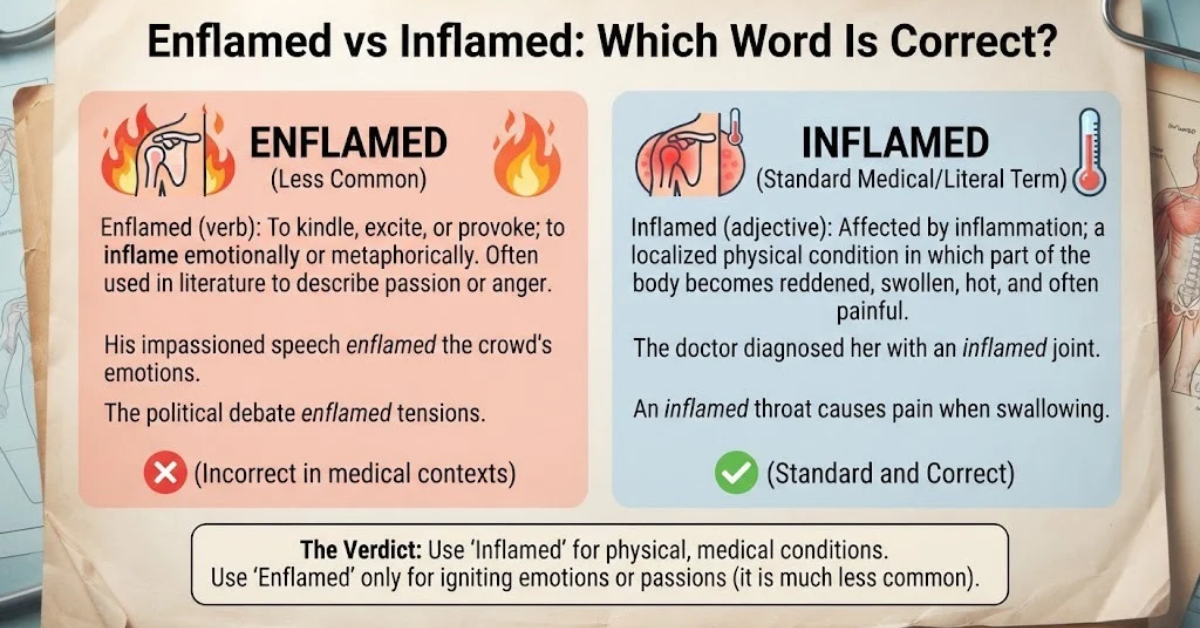
However, the two words are not always interchangeable. Inflamed is the more common choice in medical and everyday writing, particularly when describing swollen or irritated tissue. Enflamed is also a legitimate word, but it is less common and is often associated with heightened emotions, anger, or something being stirred up.
Understanding how these words differ will help you choose the right one in medical writing, everyday conversation, academic work, and creative expression.
Enflamed vs Inflamed: Which Word Is Correct?
Both enflamed and inflamed are recognized English words. The right choice depends on the meaning you want to convey.
- Inflamed: Commonly describes body tissue that is swollen, irritated, or affected by inflammation. It can also describe emotions or conflicts that have intensified.
- Enflamed: A less common variant of inflamed, often used to suggest that something has been ignited, intensified, or stirred into a heightened state.
For example:
- Correct: The doctor examined the inflamed skin around the wound.
- Correct: The controversial speech enflamed public anger.
- Also correct: The controversial speech inflamed public anger.
The last two examples demonstrate that the words can overlap when discussing emotions. In most modern writing, however, inflamed is the more familiar and natural option.
What Does Inflamed Mean?
Inflamed is the past tense and past participle of inflame. It can function as an adjective describing tissue, emotions, arguments, or situations that have become more intense.
Its meaning depends on the context.
1. Inflamed in Medical Terms
In medicine, inflamed describes tissue affected by inflammation, the body’s response to injury, infection, irritation, or other triggers.
Common signs of inflammation include:
- Redness
- Swelling
- Warmth
- Pain or tenderness
- Reduced function in the affected area
For example:
The doctor recommended treatment for the inflamed joint.
Here, inflamed refers to tissue experiencing inflammation.
Other common medical expressions include:
- Inflamed gums
- Inflamed skin
- Inflamed tonsils
- Inflamed joints
- An inflamed tendon
- An inflamed throat
Inflammation is not necessarily the same as infection. Inflammation can occur without an infection, although some infections can cause inflammation.
2. Inflamed in Everyday Language
Outside medicine, inflamed can describe feelings or situations that have become more intense, particularly anger, hostility, or disagreement.
Examples:
His careless remarks inflamed an already tense argument.
The article inflamed public opinion.
The disagreement became worse after both sides exchanged accusations.
In these examples, inflamed means intensified or made more heated rather than physically swollen.
3. Inflamed in Figurative Writing
Writers also use inflamed to communicate strong emotions, passionate reactions, or heightened tension.
For example:
Jealousy inflamed his imagination.
The rumors inflamed fears throughout the community.
This figurative use is common in journalism, literature, political commentary, and everyday conversation.
What Does Enflamed Mean?
Enflamed is a less common English variant of inflamed. It can convey the idea of something being set alight, excited, intensified, or stirred into a stronger state.
The exact meaning depends on the sentence and the writer’s intended emphasis.
1. Enflamed as a Description of Emotions
One possible use is to describe emotions that have become more intense.
For example:
The heated exchange enflamed his anger.
This means the exchange made him angrier.
However, most contemporary readers would find inflamed his anger more familiar and conventional.
2. Enflamed in Literary Writing
In literary or expressive writing, enflamed may be chosen to create a particular tone or emphasize an intense reaction.
For example:
The speech enflamed the crowd’s passions.
The word gives the sentence a forceful quality, although inflamed would also work.
3. Enflamed and the Idea of Fire
The spelling may remind readers of flame and enflame, which can mean to set something alight or cause it to burn.
For example:
The dry brush was enflamed by the spreading fire.
Although this construction is understandable, wording such as ignited, caught fire, or was set ablaze is often clearer in modern prose.
For that reason, avoid choosing enflamed merely because you want to describe a literal fire. Select a more precise expression when clarity matters.
Enflamed vs Inflamed: Key Differences
The main difference is not that one word is correct and the other is incorrect. Both are legitimate, but their frequency and typical uses differ.
| Feature | Inflamed | Enflamed |
| Correct English word | Yes | Yes |
| Frequency in modern writing | More common | Less common |
| Medical usage | Standard and widely used | Uncommon |
| Emotional meaning | Common | Possible, but less usual |
| Literal fire-related meaning | Possible in certain contexts | Possible, but often less natural |
| Best choice for general writing | Usually preferred | Use when specifically appropriate |
The practical rule: Use inflamed for medical conditions, irritated tissue, heightened emotions, and most ordinary writing. Reserve enflamed for contexts where its less common form serves a clear stylistic purpose.
Enflamed vs Inflamed Examples in Sentences
Examples make the distinction easier to understand because the context often determines which word sounds most natural.
Medical Examples
Inflamed:
- The dentist noticed that the patient’s gums were inflamed.
- She applied a recommended treatment to the inflamed area.
- The doctor checked his inflamed knee for signs of injury.
- The infection caused inflammation in the surrounding tissue.
Enflamed:
- The patient’s enflamed gums required further examination.
This sentence is understandable, but inflamed gums is the conventional medical expression and is the better choice in professional or general writing.
Emotional Examples
Inflamed:
- The accusation inflamed tensions between the neighbors.
- His comments inflamed an already sensitive debate.
- The rumor inflamed public anger.
Enflamed:
- The accusation enflamed tensions between the neighbors.
- The speech enflamed the crowd’s passions.
These examples show that both forms can convey emotional intensity. Nevertheless, inflamed is generally the safer choice because it is more widely established in contemporary usage.
Fire-Related Examples
When discussing literal flames, more direct words usually improve clarity.
Instead of:
The dry grass was enflamed.
Consider:
The dry grass caught fire.
Or:
The flames ignited the dry grass.
These alternatives communicate the physical event more directly.
Inflamed vs Enflamed in Medical Writing
Medical writing is one area where choosing the conventional term is particularly important.
Inflamed is the standard adjective used to describe tissue affected by inflammation. Healthcare professionals and medical information resources commonly use expressions such as inflamed joints, inflamed skin, and inflamed tonsils.
For example:
The patient was diagnosed with an inflamed tendon.
The word describes a physical condition, not simply an emotional state or a general sense of irritation.
It is also worth remembering that the appearance of inflamed tissue does not establish a specific diagnosis. Redness, swelling, warmth, and pain can have different causes, and a healthcare professional may need to assess the symptoms.
If you’re writing a health article, patient guide, medical report, or educational resource, choose inflamed rather than enflamed.
Inflamed vs Enflamed in Emotional Contexts
Both terms may appear in figurative descriptions, but inflamed is more common in discussions of anger, political disputes, public reactions, and interpersonal conflict.
Consider these examples:
- The announcement inflamed public outrage.
- His remarks inflamed an already difficult situation.
- The debate inflamed divisions within the community.
In each sentence, the word suggests that an existing feeling or conflict has become more intense.
Although enflamed can convey a similar idea, it may sound unusual to readers who are accustomed to the more common form.
For most business writing, news articles, essays, and online content, inflamed is the clearest option.
Why Do People Confuse Enflamed and Inflamed?
Several factors explain why these words are easy to mix up.
1. Similar Spelling
The words differ by only one letter at the beginning. Since both are associated with the verb inflame or enflame, it is easy to assume they have identical usage in every context.
2. Overlapping Meanings
Both words can describe something that has become more intense. This overlap is especially noticeable when the subject is anger, excitement, or a heated dispute.
3. The Connection With Flame
The word flame suggests fire, heat, and intensity. That association can make enflamed seem like the obvious choice in situations involving anger or irritation.
However, common usage matters. Even when two words are valid synonyms, one may be much more natural in a particular setting.
4. Medical and Figurative Meanings
The word inflamed is widely used in both medical and figurative contexts. Because it appears so often in descriptions of irritated tissue and heightened emotions, it has become the more versatile everyday choice.
Synonyms for Inflamed and Enflamed
If you’re looking for a more precise word, the best synonym depends on the context.
Synonyms for Medical Inflammation
When describing a physical condition, you might use:
- Swollen
- Irritated
- Reddened
- Tender
- Sore
These words are not exact medical equivalents. For example, tissue may be inflamed without being visibly swollen, and irritation does not always indicate inflammation.
Synonyms for Emotional Intensity
When describing feelings or conflict, consider:
- Aggravated
- Intensified
- Provoked
- Heightened
- Escalated
- Inflamed
For example:
The comment intensified the disagreement.
This may be clearer than saying that the comment enflamed the disagreement.
Synonyms for Literal Fire
When discussing combustion, choose a word that describes the event precisely:
- Ignited
- Kindled
- Burning
- Ablaze
- Set alight
For example:
A spark ignited the dry leaves.
This is more direct than using enflamed in most contemporary writing.
How to Remember the Difference
You do not need to memorize a complicated grammar rule to choose correctly.
Use these simple guidelines:
- For a medical condition, choose inflamed. Think of inflamed skin, gums, joints, or tissue.
- For anger or conflict, usually choose inflamed. It is the more familiar word in expressions such as inflamed tensions and inflamed public opinion.
- For a literal fire, choose a precise fire-related verb. Words such as ignited and caught fire usually communicate the meaning more clearly.
- Use enflamed selectively. It is a valid but less common variant, so consider whether it genuinely improves the sentence.
When in doubt, inflamed will usually be the most natural choice.
Frequently Asked Questions
Is enflamed a real word?
Yes. Enflamed is a recognized English word and a less common variant of inflamed. It can describe something that has been intensified or stirred up, although inflamed is more common in modern writing.
Is inflamed or enflamed correct?
Both are correct words, but they are not equally common. Inflamed is the preferred choice in most contexts, especially medical writing and descriptions of heightened emotions.
What is the difference between enflamed and inflamed?
Inflamed is the more common form and is widely used to describe swollen or irritated tissue, anger, and heightened tensions. Enflamed is a less common variant that can carry similar figurative meanings.
Is enflamed a medical term?
It is not the conventional term in modern medical writing. Healthcare professionals generally use inflamed when describing tissue affected by inflammation.
Can you say that your skin is enflamed?
Readers may understand the expression, but inflamed skin is the standard and more natural phrase. If the skin is irritated, red, or swollen, use terminology that accurately describes the condition.
Can inflamed describe anger?
Yes. Inflamed can describe anger or other emotions that have become more intense. For example, “The criticism inflamed his anger” means the criticism made him angrier.
Does inflamed always mean infected?
No. Inflammation is the body’s response to injury, irritation, infection, or other triggers. An area can be inflamed without being infected, and the word alone does not establish the underlying cause.
What is the past tense of inflame?
The past tense is inflamed. For example, “The argument inflamed public opinion.” The past participle is also inflamed, as in “The tissue was inflamed.”
What is the opposite of inflamed?
There is no single opposite that works in every context. For physical tissue, words such as unaffected or noninflamed may be appropriate. For emotions, possible opposites include calmed, soothed, or eased, depending on the sentence.
Which word should I use in an essay?
Use inflamed unless you have a specific reason to choose enflamed. The more common form is generally clearer and more suitable for academic, professional, and general writing.
Conclusion: Enflamed vs Inflamed
When comparing enflamed vs inflamed, the key point is that both words are valid, but inflamed is much more common in modern English.
Use inflamed when describing medical conditions such as irritated tissue, as well as anger, public outrage, and escalating disagreements. Although enflamed can express similar ideas, it is less familiar and is rarely the best choice for ordinary or professional writing.
The next time you’re unsure which word to use, consider the context and choose the term that communicates your meaning most clearly. In most cases, inflamed is the word you’re looking for.