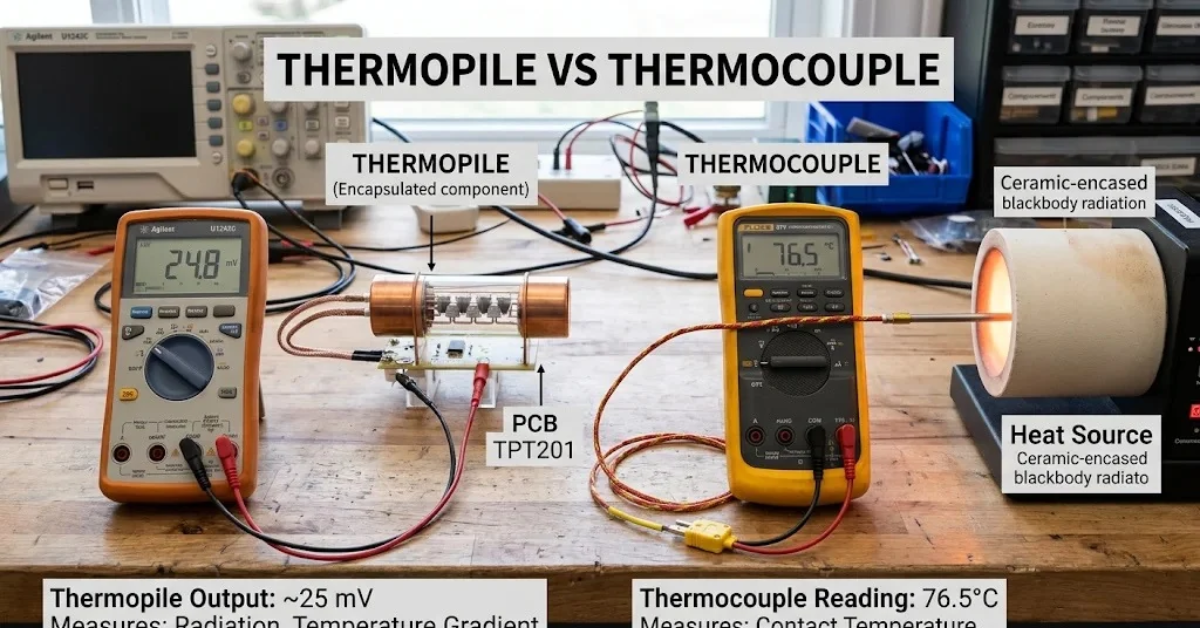
Both thermopiles and thermocouples can turn heat into an electrical signal, but they don’t do exactly the same job. If you’ve encountered these devices in gas water heaters, fireplaces, furnaces, temperature sensors, or industrial equipment, you may have wondered about the difference between them.
Understanding thermopile vs thermocouple comes down to how many thermoelectric elements are used, how much voltage they produce, and what the application requires. A thermocouple typically uses one thermoelectric junction pair, while a thermopile combines multiple thermocouples to produce a larger voltage.
That difference matters. A thermocouple is commonly used for temperature measurement and flame-safety systems, while a thermopile can generate a stronger electrical signal for applications that need more output.
Let’s look at how each device works, where they’re used, and how to choose between them.
What Is a Thermocouple?
A thermocouple is a temperature-sensing device made from two different electrical conductors joined together at one end. When the measuring junction experiences a different temperature from the reference junction, the device produces a small voltage.
This effect is known as the Seebeck effect, a thermoelectric phenomenon in which a temperature difference creates an electrical potential.
The voltage produced depends on the conductor materials and the temperature difference between the two junctions. A measuring instrument can use that voltage to estimate temperature.
How Does a Thermocouple Work?
A thermocouple works through a relatively simple process:
- Two different conductive materials are joined to form a measuring junction.
- The measuring junction is exposed to the temperature being measured.
- The reference junction is maintained at a known temperature or its temperature is measured electronically.
- A temperature difference creates a small thermoelectric voltage.
- An instrument interprets the voltage to calculate the temperature.
For example, in an industrial temperature-measurement system, a thermocouple may be placed inside an oven or furnace. Its output is sent to a temperature controller, which uses the signal to monitor or regulate heating.
Common Types of Thermocouples
Thermocouples come in several types, each designed for particular temperature ranges, environments, and accuracy requirements.
| Type | Materials | Common Applications |
| Type K | Chromel and Alumel | General industrial temperature measurement |
| Type J | Iron and Constantan | Furnaces and industrial equipment |
| Type T | Copper and Constantan | Refrigeration and low-temperature measurement |
| Type E | Chromel and Constantan | Applications requiring relatively high sensitivity |
| Type N | Nicrosil and Nisil | High-temperature industrial environments |
| Type R | Platinum-rhodium and platinum | High-temperature laboratory and industrial use |
| Type S | Platinum-rhodium and platinum | Furnaces and precision applications |
| Type B | Platinum-rhodium alloys | Very high-temperature measurement |
The best type depends on the temperature range, atmosphere, required accuracy, and expected service life.
What Is a Thermopile?
A thermopile is a device made by connecting multiple thermocouples, usually electrically in series, to produce a larger voltage from a temperature difference.
Each thermocouple contributes a small thermoelectric voltage. When the elements are connected in series with the correct polarity, their voltages add together.
This makes a thermopile useful when an application needs a stronger electrical signal than a single thermocouple can typically provide.
Thermopiles are used in temperature sensing, infrared radiation detection, gas appliance safety systems, and certain energy-harvesting applications.
How Does a Thermopile Work?
A thermopile follows the same basic thermoelectric principle as a thermocouple, but it uses multiple thermocouple junctions.
Here’s the general process:
- Multiple thermocouple elements are arranged in a circuit.
- Their hot junctions are exposed to one temperature or heat source.
- Their cold junctions are exposed to another temperature.
- Each element generates a small voltage through the Seebeck effect.
- The connected elements produce a combined output voltage.
For example, if several thermocouple elements each generate a small voltage under the same temperature difference, connecting them in series increases the total output.
The result is a device that can produce a more useful voltage for certain electronic circuits.
Where Are Thermopiles Used?
Thermopiles have several practical applications, including:
- Gas fireplaces: Some systems use a thermopile heated by a pilot flame to generate electricity for control circuits.
- Gas water heaters: Certain models use thermopile-based systems to supply electrical power to controls.
- Infrared thermometers: Thermopile sensors detect infrared radiation and convert the resulting temperature difference into an electrical signal.
- Non-contact temperature sensors: They help measure surface temperatures without direct physical contact.
- Thermal energy harvesting: Specialized thermopile devices can generate electrical power from a temperature difference.
Their ability to produce a higher combined voltage makes them useful in systems where a stronger thermoelectric signal is needed.
Thermopile vs Thermocouple: Main Differences
The biggest difference is the number of thermoelectric elements and the combined voltage they can produce.
A thermocouple generally consists of a single measuring junction formed by two different conductors. A thermopile contains multiple thermocouples connected together to increase the output.
Here’s a side-by-side comparison:
| Feature | Thermocouple | Thermopile |
|---|---|---|
| Construction | One thermoelectric junction pair | Multiple thermocouple elements |
| Operating principle | Seebeck effect | Seebeck effect |
| Voltage output | Generally very small | Generally higher because element voltages add |
| Main purpose | Temperature measurement and sensing | Temperature sensing and higher-output thermoelectric conversion |
| Electrical output | Usually measured by an instrument | May provide a stronger signal or power for a suitable circuit |
| Construction | Relatively simple | More complex |
| Common applications | Industrial sensors, ovens, furnaces | Infrared sensors, fireplaces, water heaters |
| Temperature measurement | Yes | Yes, with suitable design and calibration |
| Power generation | Limited output | Can generate more usable electrical output in suitable applications |
One important point: a thermopile is not automatically more accurate than a thermocouple. Accuracy depends on the sensor design, calibration, materials, temperature range, installation, and measurement electronics.
Thermopile vs Thermocouple Voltage Output
Voltage output is one of the most noticeable differences between these devices.
A typical thermocouple produces a small voltage, often measured in microvolts or millivolts depending on its type and temperature difference.
A thermopile combines the outputs of multiple thermocouple elements. When connected in series, the individual voltages add together.
Why Does a Thermopile Produce More Voltage?
Imagine that one thermocouple produces a voltage of 5 millivolts under a particular temperature difference.
If four similar thermocouple elements experience the same temperature difference and are connected in series with the correct polarity, their combined output would ideally be:
5 mV × 4 = 20 mV
This is a simplified example. Actual output depends on the materials, junction temperatures, circuit arrangement, and operating conditions.
The higher voltage can make it easier to interface with certain electronic circuits.
Does Higher Voltage Mean More Power?
Not necessarily.
Voltage is only one part of electrical power. The amount of current a device can supply and the load connected to it also matter.
Electrical power is calculated using:
Power = Voltage × Current
A thermopile may produce a higher open-circuit voltage than a single thermocouple, but its available power depends on its internal resistance, temperature difference, and electrical load.
This is why a higher voltage rating alone does not tell you how much useful power a thermopile can deliver.
Thermopile vs Thermocouple in Gas Appliances
One place where people frequently encounter the difference is in gas-powered appliances.
Both devices can be involved in flame-safety systems, but they may perform different roles depending on the appliance design.
Thermocouples in Gas Water Heaters and Furnaces
A traditional gas appliance may use a thermocouple positioned near the pilot flame.
When the pilot flame heats the thermocouple, it produces a small electrical current. This current can operate a safety magnet in a gas valve.
If the pilot flame goes out and the thermocouple cools, the electrical output falls. The safety mechanism can then close the gas supply, helping prevent unburned gas from continuing to flow.
This is an important safety function.
Thermopiles in Gas Fireplaces and Water Heaters
Some gas fireplaces and water heaters use a thermopile instead.
The pilot flame heats the thermopile, allowing it to generate a higher electrical output than a single thermocouple typically provides.
Depending on the appliance, that electricity may power a control circuit, operate a gas valve, or support other low-voltage functions.
This can allow certain appliances to operate without a conventional external electrical supply for those functions.
However, not every gas appliance uses the same design. Always check the manufacturer’s specifications before identifying or replacing a component.
Advantages and Disadvantages of Thermocouples
Thermocouples remain popular because they are relatively simple, durable, and suitable for many temperature-measurement environments.
Advantages
- Wide temperature range: Different thermocouple types can measure temperatures from cryogenic conditions to very high industrial temperatures.
- Simple construction: They generally have a straightforward design.
- Fast response: Small junctions can respond quickly to temperature changes.
- Durability: Many designs can withstand demanding industrial environments.
- Variety: Multiple thermocouple types are available for different applications.
Disadvantages
- Small voltage output: The signal often requires amplification or sensitive measurement electronics.
- Reference-junction requirements: Accurate temperature measurement requires appropriate reference-junction compensation.
- Calibration considerations: Accuracy can change with aging, contamination, and material degradation.
- Electrical noise: Their small signals can be affected by electromagnetic interference and poor wiring practices.
Advantages and Disadvantages of Thermopiles
Thermopiles are useful when a design benefits from combining multiple thermoelectric elements.
Advantages
- Higher combined voltage: Multiple elements can add their outputs together.
- Useful for infrared detection: Thermopile sensors can detect thermal radiation without touching the measured object.
- Low-maintenance designs: Many thermopile sensors have no moving parts.
- Suitable for low-voltage systems: Certain gas appliances use thermopiles to power their control circuits.
- Flexible applications: They are used in sensing, temperature measurement, and energy harvesting.
Disadvantages
- More complex construction: Multiple thermocouple elements require careful arrangement and manufacturing.
- Temperature-difference dependence: Output depends on the thermal conditions across the elements.
- Limited power in many designs: A thermopile is not necessarily a replacement for a conventional power supply.
- Application-specific performance: Sensitivity, response time, and accuracy depend heavily on the design.
- Potentially higher cost: Some specialized thermopile sensors can cost more than basic thermocouples.
Which Is Better: Thermopile or Thermocouple?
Neither device is universally better. The right choice depends on what you want to measure or operate.
A thermocouple is often the better option when you need a straightforward temperature sensor for an industrial process, oven, furnace, or similar application.
A thermopile may be more suitable when you need a higher thermoelectric voltage, want to detect infrared radiation, or are working with a gas appliance designed to use thermopile output.
Consider these points before choosing:
- Purpose: Are you measuring temperature, detecting infrared radiation, or powering a control circuit?
- Output requirements: Does your circuit need the voltage produced by a single thermocouple or a thermopile?
- Temperature range: Can the device operate safely within the expected temperatures?
- Accuracy: What measurement accuracy and calibration requirements does the application have?
- Installation: Does the device fit the appliance or measurement system?
- Manufacturer specifications: Does the replacement or sensor match the original equipment requirements?
For gas appliances, compatibility is particularly important. A thermocouple and thermopile are not automatically interchangeable, even if they look similar or perform related functions.
How to Tell Whether Your Appliance Uses a Thermopile or Thermocouple
If you’re troubleshooting a gas fireplace, water heater, or furnace, identifying the correct component is an important first step.
Here are some ways to check:
1. Read the Appliance Manual
The manufacturer’s documentation usually identifies the flame-sensing or pilot-control component.
Look for terms such as thermocouple, thermopile, pilot generator, or millivolt generator.
2. Check the Component Label
Some components have a model number or manufacturer marking that can help identify their type.
Use the part number to check the manufacturer’s specifications.
3. Look at the Wiring
A traditional thermocouple often has a single connection to the gas valve through a specialized metal fitting.
A thermopile commonly has two electrical output leads or terminals, although wiring arrangements vary by model.
Wiring appearance is only a clue, not a definitive identification method.
4. Follow the Manufacturer’s Troubleshooting Procedure
A technician may measure the component’s output using an appropriate multimeter and the manufacturer’s specified test conditions.
The expected voltage depends on the model, temperature, connection arrangement, and whether the measurement is taken under load.
Safety reminder: Gas appliances can create fire, explosion, and carbon monoxide hazards. Do not bypass flame-safety devices or attempt repairs beyond your training. If you smell gas, leave the area and contact the gas supplier or emergency service from a safe location.
Frequently Asked Questions
1. What is the main difference between a thermopile and a thermocouple?
A thermocouple generally uses one pair of different conductors to produce a small voltage from a temperature difference. A thermopile combines multiple thermocouples to produce a larger combined voltage.
2. Is a thermopile just multiple thermocouples?
Essentially, yes. A thermopile is an arrangement of multiple thermocouple elements, commonly connected electrically in series so their thermoelectric voltages add together.
3. Which produces more voltage, a thermopile or thermocouple?
A thermopile generally produces a higher voltage because it combines the output of multiple thermocouple elements. The exact output depends on its design and operating temperature difference.
4. Is a thermopile more accurate than a thermocouple?
Not automatically. Accuracy depends on the materials, construction, calibration, operating conditions, and measurement electronics. A well-designed thermocouple can be more appropriate and accurate for a particular application than a thermopile.
5. Can I replace a thermocouple with a thermopile?
Not unless the appliance manufacturer specifically approves that replacement. The two devices can have different electrical outputs, connections, and control requirements.
6. Why does a gas fireplace use a thermopile?
Some gas fireplaces use thermopiles to generate electricity from the pilot flame. The resulting voltage can operate the fireplace’s millivolt control system without relying on a conventional external power supply for those functions.
7. Does a thermopile generate electricity?
Yes. It converts a temperature difference into electrical energy through the Seebeck effect. The amount of usable power depends on the temperature difference, device design, and connected load.
8. What is the Seebeck effect?
The Seebeck effect is the production of an electrical voltage when different points or junctions in a thermoelectric circuit experience a temperature difference. It is the operating principle behind both thermocouples and thermopiles.
9. Can a thermopile measure temperature?
Yes. Thermopile sensors can measure temperature differences or detect infrared radiation emitted by an object. With suitable calibration and electronics, they can be used in non-contact temperature measurement.
10. Do thermocouples need an external power supply?
A thermocouple generates its own small thermoelectric voltage and does not need an external supply to produce that signal. However, the measurement instrument or control system connected to it may require electrical power.
Conclusion
Understanding thermopile vs thermocouple becomes much easier once you know that both devices rely on the Seebeck effect but use different arrangements of thermoelectric elements.
A thermocouple is a practical choice for many temperature-measurement applications because of its simple construction, wide operating range, and durability. A thermopile combines multiple thermocouples to produce a higher voltage, making it useful in infrared sensing, certain gas appliances, and specialized energy-harvesting systems.
The best option depends on the required voltage, temperature range, accuracy, and intended application. If you’re selecting a replacement for a gas appliance, always follow the manufacturer’s specifications rather than choosing a component based only on appearance.
For more technical guidance, explore related articles on temperature sensors, thermoelectric generators, and industrial measurement devices before making your selection.