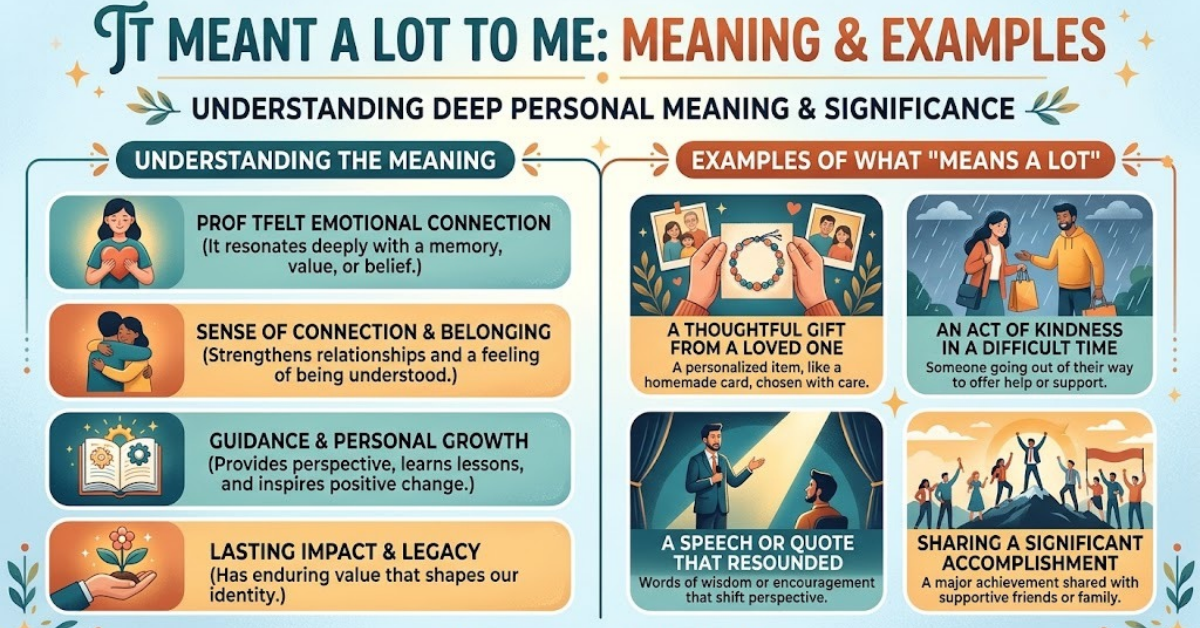
Sometimes, a simple sentence can express feelings that are difficult to put into words. The phrase “it meant a lot to me” is one of those expressions. Whether someone gives you a thoughtful gift, offers support during a difficult time, remembers an important occasion, or simply makes you feel appreciated, these words help communicate how much that moment mattered to you.
But what does “it meant a lot to me” really mean? How do you use it naturally in a conversation, text message, or heartfelt note? And are there other ways to express the same feeling?
In this guide, we’ll explore the meaning of the phrase, its correct usage, real-life examples, similar expressions, and common grammar questions to help you communicate your feelings more clearly.
What Does “It Meant a Lot to Me” Mean?
The phrase “it meant a lot to me” means that something was very important, valuable, touching, or emotionally significant to you.
People use it to express appreciation for an action, experience, gesture, gift, conversation, or relationship. The phrase often communicates more than simple gratitude because it explains the emotional impact something had on the speaker.
For example:
- “Thank you for checking on me when I was having a difficult week. It meant a lot to me.”
- “You remembered my birthday, and that meant a lot to me.”
- “Having my family there on graduation day meant a lot to me.”
In each example, the speaker is saying that the action or experience mattered personally.
The phrase can express happiness, gratitude, comfort, love, respect, or even sadness when someone reflects on a meaningful memory.
What Does It Mean When Someone Says “It Meant a Lot to Me”?
When someone tells you that something meant a lot to them, they are usually communicating that your words or actions had a meaningful effect on them.
Depending on the situation, it may mean:
- They felt appreciated: Your kindness helped them feel valued.
- They felt supported: Your presence or encouragement made a difficult situation easier.
- They felt remembered: You paid attention to something important to them.
- They felt emotionally connected: Your gesture strengthened their sense of closeness with you.
- They genuinely appreciated your effort: They noticed the thought or care behind what you did.
For instance, if a friend says, “Your message meant a lot to me,” they may be telling you that your words arrived at the right time or provided comfort when they needed it.
However, the exact meaning depends on the context. The phrase can express friendship, romantic affection, professional appreciation, or simple gratitude. It does not automatically mean someone has romantic feelings for you.
“It Meant a Lot to Me” vs. “It Means a Lot to Me”
These two expressions are closely related, but they refer to different time frames.
It Meant a Lot to Me
Use “it meant a lot to me” when talking about something that happened in the past.
Examples:
- “Your visit meant a lot to me.”
- “The support you gave me during college meant a lot to me.”
- “Being invited to the ceremony meant a lot to me.”
The phrase looks back on an experience or gesture that was meaningful.
It Means a Lot to Me
Use “it means a lot to me” when describing something that matters to you now or continues to matter.
Examples:
- “Your friendship means a lot to me.”
- “Knowing that you believe in me means a lot to me.”
- “Your continued support means a lot to me.”
The difference is simple: “meant” usually points to the past, while “means” emphasizes the present or an ongoing feeling.
Something that happened in the past can still matter today, so the choice depends on what you want to emphasize.
When Should You Use “It Meant a Lot to Me”?
This phrase works well whenever you want to acknowledge the emotional significance of another person’s actions or an important experience.
1. When Someone Helps You
If someone supports you during a stressful period, you can use the phrase to show that their help was genuinely appreciated.
Example:
“Thank you for helping me when I was struggling. Your kindness meant a lot to me.”
2. When You Receive a Thoughtful Gift
A gift does not have to be expensive to be meaningful. Sometimes, the thought behind it is what makes it special.
Example:
“You remembered how much I wanted this book. That meant a lot to me.”
3. When Someone Remembers an Important Occasion
Birthdays, graduations, anniversaries, and personal milestones often become more special when someone makes an effort to acknowledge them.
Example:
“Thank you for remembering my graduation. Having you celebrate with me meant a lot to me.”
4. When Someone Offers Emotional Support
A listening ear or a few comforting words can make a difficult experience feel less lonely.
Example:
“Thank you for listening without judging me. It meant a lot to me to know I could talk to you.”
5. In Professional Situations
The phrase is also suitable for expressing appreciation at work, especially when someone offers mentorship, recognition, or encouragement.
Example:
“Thank you for recognizing my contribution to the project. Your feedback meant a lot to me.”
In professional settings, it can sound warm and sincere without being overly personal.
Examples of “It Meant a Lot to Me” in Different Situations
The best way to understand an expression is to see how it works in everyday communication.
In a Text Message
“Thank you for checking in on me yesterday. I really needed that, and it meant a lot to me.”
In a Romantic Relationship
“The little things you do to make me happy mean more than you realize. That surprise dinner meant a lot to me.”
With Friends
“Thanks for showing up when I needed someone. Your friendship has always meant a lot to me.”
With Family
“Having everyone together for the holidays meant a lot to me. Those are the moments I want to remember.”
After Receiving a Compliment
“Thank you for saying that. I’ve been working hard, so hearing those words meant a lot to me.”
After a Difficult Experience
“You stayed by my side when things were falling apart. I may not have said it at the time, but it meant a lot to me.”
In a Thank-You Note
“Thank you for your generosity and thoughtfulness. Your support during this important time meant a lot to me, and I truly appreciate everything you did.”
These examples show that the phrase fits both casual conversations and more meaningful messages.
Heartfelt Ways to Say “It Meant a Lot to Me”
Sometimes, you may want to express the same feeling without repeating the exact phrase. Choosing an alternative can help your message sound more personal.
Here are some useful alternatives, along with the situations in which they work best.
| Alternative phrase | Best used when |
| It really touched me. | Something made you feel emotional. |
| I truly appreciated it. | You want to express sincere gratitude. |
| It was incredibly meaningful to me. | The experience had deep personal significance. |
| I’ll always remember it. | You want to emphasize a lasting memory. |
| It made me feel valued. | Someone’s actions helped you feel appreciated. |
| I’m grateful you did that for me. | You want to acknowledge a specific gesture. |
| Your kindness made a difference. | Someone helped or supported you. |
| It meant more than you know. | You want to emphasize a strong emotional impact. |
| I’ll always be thankful for that. | You want to express lasting gratitude. |
| I won’t forget what you did for me. | You want to acknowledge a memorable act of kindness. |
Choose the expression that best matches the situation. For example, “I truly appreciated it” is suitable for a professional thank-you, while “It really touched me” may feel more natural when responding to an emotional gesture.
How to Respond When Someone Says “It Meant a Lot to Me”
If someone tells you that your actions meant a lot to them, a thoughtful response can acknowledge their feelings without making the moment awkward.
Here are some natural replies:
Warm and friendly
- “I’m really glad I could be there for you.”
- “That means a lot to hear.”
- “You don’t have to thank me. I’m happy I could help.”
Heartfelt
- “I’m glad it made a difference. You deserve that kind of support.”
- “I’m happy it meant something to you. I genuinely wanted to do it.”
- “You matter to me, and I’m glad you felt supported.”
Casual
- “Of course! Anytime.”
- “I’m glad you liked it.”
- “That makes me happy to hear.”
Professional
- “I’m glad I could help.”
- “You’re very welcome. I appreciate you saying that.”
- “I’m pleased the support was helpful.”
The key is to respond naturally. You do not need a long or elaborate answer; a sincere acknowledgment is often enough.
Is “It Meant a Lot to Me” Romantic?
Not necessarily.
Although the phrase can appear in romantic conversations, it is not exclusively romantic. People use it to express appreciation toward friends, parents, siblings, teachers, colleagues, mentors, and others who have made a positive impact on their lives.
For example:
- A friend may say your encouragement meant a lot to them.
- A parent may say your visit meant a lot to them.
- A colleague may say your recommendation meant a lot to them.
- A romantic partner may say your thoughtful gesture meant a lot to them.
If someone uses the phrase with you, consider the surrounding conversation, your relationship, and their behavior rather than assuming it has a romantic meaning.
The words communicate significance and appreciation, but they do not independently reveal the full nature of someone’s feelings.
Is “It Meant a Lot to Me” Grammatically Correct?
Yes. “It meant a lot to me” is grammatically correct English.
The sentence contains three main parts:
- It: The subject, referring to an action, event, gesture, or experience.
- Meant: The past-tense form of the verb mean.
- A lot to me: A phrase indicating the degree of personal importance.
For example:
“Your advice meant a lot to me.”
Here, your advice is the thing that mattered, and meant shows that the speaker is referring to the past.
You can also expand the phrase to provide more detail:
- “It meant a lot to me that you came.”
- “It meant a lot to me to receive your support.”
- “Your words meant more to me than I can explain.”
All three constructions are natural and grammatically acceptable.
Common Mistakes to Avoid
Although the expression is straightforward, a few mistakes can make your writing less natural.
1. Confusing “Meant” and “Mean”
Incorrect for a past event:
“Your visit mean a lot to me yesterday.”
Correct:
“Your visit meant a lot to me yesterday.”
Use meant when referring to a past experience.
2. Using the Phrase Without Context
Saying “It meant a lot to me” is perfectly acceptable, but adding what mattered can make the message more personal.
General:
“It meant a lot to me.”
More specific:
“Your encouragement before my interview meant a lot to me.”
The second version explains why the gesture was important.
3. Assuming It Always Signals Deep Emotion
The phrase can express anything from polite appreciation to profound gratitude. Its emotional intensity depends on the situation, the speaker, and the way the words are delivered.
Avoid interpreting it as a declaration of love or a sign of a particular relationship without additional context.
4. Overusing the Expression
If you’re writing a long thank-you message, consider varying your language with expressions such as “I appreciate your support,” “Your kindness touched me,” or “I’ll always be grateful.”
This keeps your writing natural while preserving the sincerity of your message.
Frequently Asked Questions
What does “it meant a lot to me” mean in simple words?
It means that something was important to you and made you feel appreciated, happy, supported, or emotionally touched. It is a way of expressing sincere gratitude or acknowledging the importance of an experience.
Is “it meant a lot to me” a compliment?
It can function as a compliment because it tells someone that their actions or words had a positive impact on you. However, it is more specifically an expression of appreciation than a direct compliment about someone’s qualities or appearance.
What is another way to say “it meant a lot to me”?
You can say “I truly appreciated it,” “It really touched me,” “It was very meaningful to me,” or “I’ll always be grateful for that.” The best alternative depends on whether you want to emphasize gratitude, emotion, or lasting significance.
What is the difference between “it meant a lot to me” and “it means a lot to me”?
“It meant a lot to me” generally refers to something meaningful in the past. “It means a lot to me” usually describes something that matters in the present or continues to matter over time.
Can I say “it meant a lot to me” to a friend?
Absolutely. It is a natural way to show a friend that you appreciate their kindness, encouragement, presence, or support. For example, “Thank you for being there for me. It meant a lot to me.”
How do you respond to “it meant a lot to me”?
You can respond with “I’m glad I could help,” “That means a lot to hear,” or “You’re very welcome.” Choose a reply that reflects your relationship and the situation.
Does “it meant a lot to me” mean someone loves you?
No, not necessarily. The phrase can express gratitude, friendship, respect, or affection, but it does not automatically indicate romantic love. Context is important when interpreting someone’s intentions.
Is “it meant a lot for me” correct?
In most situations, the natural expression is “it meant a lot to me.” The phrase “a lot for me” can be correct in other constructions, but when expressing personal significance, use “to me.”
Conclusion
The phrase “it meant a lot to me” is a simple yet powerful way to express gratitude, appreciation, and emotional significance. It tells someone that their actions, words, or presence mattered to you in a meaningful way.
You can use it when thanking a friend, acknowledging a thoughtful gift, appreciating professional support, or reflecting on an unforgettable experience. For a more personal message, explain what mattered and why it made a difference.
Ultimately, meaningful communication does not depend on using complicated words. A sincere sentence such as “Your kindness meant a lot to me” can express appreciation more effectively than a long explanation.
The next time someone makes a positive difference in your life, let them know. Sometimes, hearing that their actions mattered is one of the most meaningful forms of appreciation you can offer.